
SEO for Wholesale Distributors: The 2026 Playbook for Reseller Buyers and Bulk Orders
The 2026 playbook for wholesale distributor SEO: reseller queries, MOQ pages, wholesale marketplaces, Pumice at scale.
Matt Payne
September 8, 2026
A generic ai product meta description generator will write you 155 characters in seconds. You paste in a title and a few attributes, and back comes something clean, grammatical, and accurate. Run it across four thousand SKUs and you have four thousand of them by lunch.
Then you look at the google results 1st page you were trying to win, and yours says almost exactly what the nine competitor products around it say. Same phrasing, same benefit, same three attributes, nothing unique. Your conversions don’t go up, and your SEO rank doesn’t improve.
That is not a coincidence and it is not really a quality problem. Nine competitors fed the same manufacturer copy into the same type of ai tool, and the tool you used is just focused on writing clean copy, not copy that actually converts.
A meta description does not get read in isolation. It competes against everything else on the page for a click, which means the useful question is not whether a generator can write one. All of them can. The question is whether it knows what it is competing with, and what buyers want to read.
The length and framing rules still matter, and they are worth getting right. But the difference between a description that earns a click and one that fills a field is upstream of the writing, in what the generator was allowed to see before it started. The Pumice Merchandising Pipeline and Product Optimization Playbook are built around that.
We’ll walk through what a good product meta description actually has to do in 2026, the specific inputs generic tools are missing, and how to tell the two apart when you evaluate one.
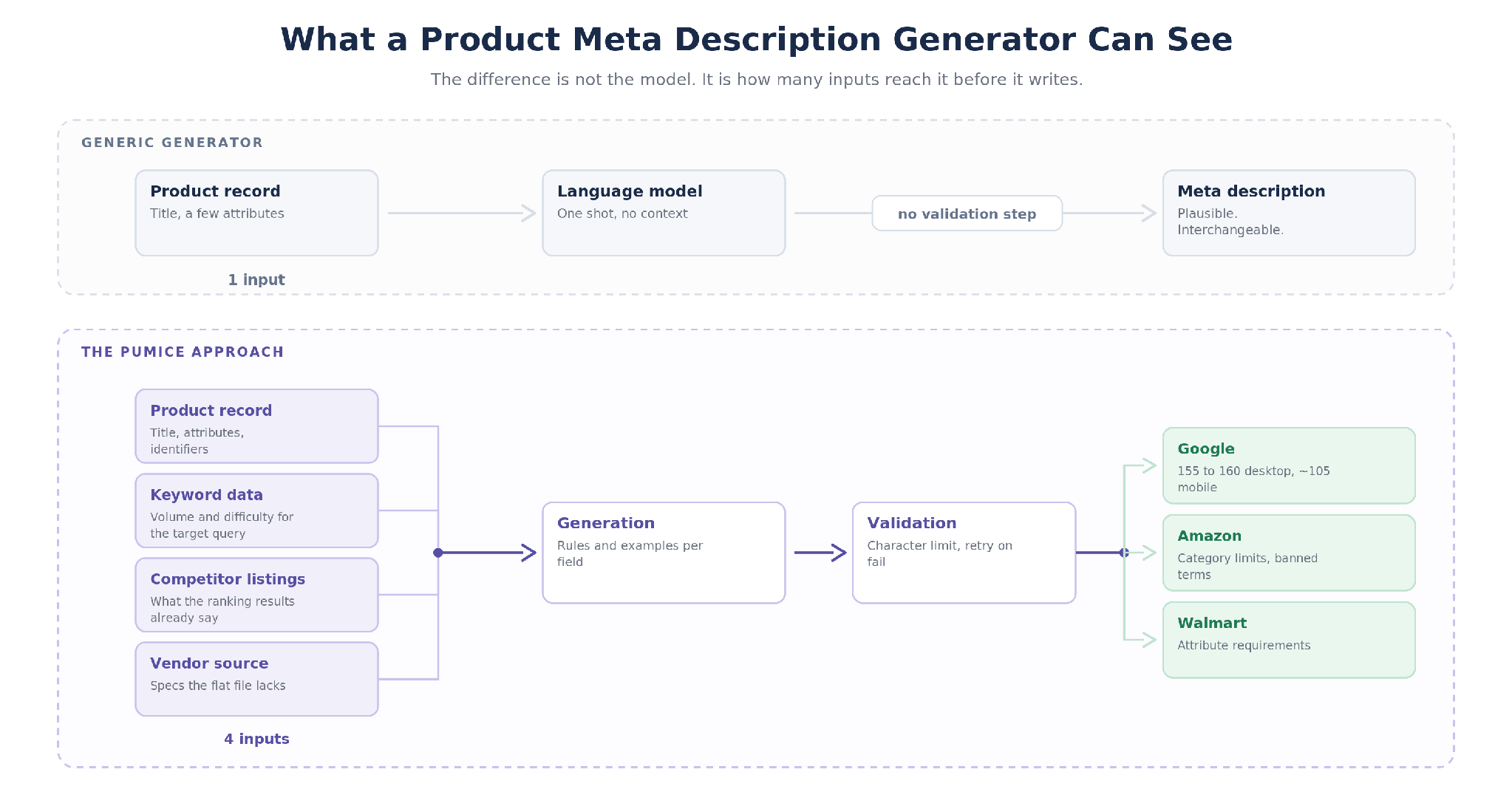
Before evaluating any generator it is worth being specific about what you are asking it to produce, because the tools on this market mostly optimize for filling the field rather than winning the click.
The familiar advice is 155 to 160 characters. That is a reasonable working limit, but Google truncates on rendered width rather than character count, so a description full of wide characters cuts earlier than one full of narrow ones. Mobile clips harder, closer to 105 characters in practice, and mobile is where most product queries happen.
The practical rule is to put the thing that earns the click inside the first 105 characters and treat everything after that as a bonus that may never be seen. Most generated descriptions do the opposite, opening with the brand and product type and saving the differentiator for the end, where a phone will cut it off.
Two jobs sit in tension here. Google bolds query terms in the snippet, which draws the eye and signals relevance, so the search term should appear early. But a description that is only keywords reads like a database record and converts badly.
The workable split is the query term in the opening clause and a concrete reason to click immediately after, where the reason is specific to the product rather than generic. Free shipping and great quality appear on every result. Ships in two days from a US warehouse, or fits 2015 to 2022 models, does not.
Google replaces meta descriptions when it judges that a different passage from the page better matches the query, and it does this often. Rewrites are more likely when the description is generic, when it duplicates other pages on the site, or when the query is long tail and the page contains a better literal answer.
This matters for a catalog specifically. Templated descriptions generated from the same pattern across thousands of SKUs are exactly the case Google most often overrides, which means a bulk run that produces four thousand near-identical strings may not be published as written. Specificity per product is what keeps the description you wrote on the page.
Answer engines pull from page content rather than the meta description tag itself, but the qualities are the same: stated attributes, answered questions, and specifics a model can quote. A description that names a material, a size and a compatibility is describing a product that the underlying page probably documents properly, and that page is the one an answer engine cites.
Generic ai generators aren’t poorly designed generators, they are misaligned to what a good product meta description generator should focus on.
Give a tool a product record and it writes from the product record. It frontloads whatever the title happens to say, which is usually the brand and the product type, because that is the most prominent thing it can see.
What it cannot see is the query and buyer intent. It does not know that the page has impressions for a compatibility phrase nobody at your company thought to write down, or that the term buyers actually use is three words different from the one in your title. Across a catalog that produces thousands of descriptions optimized for nothing in particular, each one grammatically fine and none of them aimed at the goals of the meta description.
This is the failure that is easiest to verify and hardest to notice from inside your own catalog. Search a product you sell, read the ten descriptions on the page, and count how many say the same three things in the same order.
The reason is mechanical. Nine of those listings were written from the same manufacturer copy, by the same handful of tools, none of which could see the other eight while it wrote. Every one of them produced a reasonable summary of the product. Collectively they produced a page where nothing stands out, which means the click goes to whoever has the best brand recognition rather than the best description.
A one-shot generator writes, hits the character limit, and stops. Nothing checks the phrasing against what is already ranking, whether the angle is taken, whether the query term appears in a position Google will bold, or whether the description is generic enough that Google will replace it.
So the output is plausible, which is the problem. A plausible meta description passes review, ships to the catalog, and underperforms quietly for a year because nobody can point at what is wrong with it.
None of this is a model quality argument. A frontier model given the query, the ten competing listings and the product data will write a better description than a small model given the same three things, but the gap between those two is much smaller than the gap between having those inputs and not having them. The fix is upstream of the writing.
Seven things separate a generator that fills a field from one that produces meta descriptions that actually work. They are roughly in order of how much difference they make, and the ordering matters, because most vendor comparisons lead with the last three.
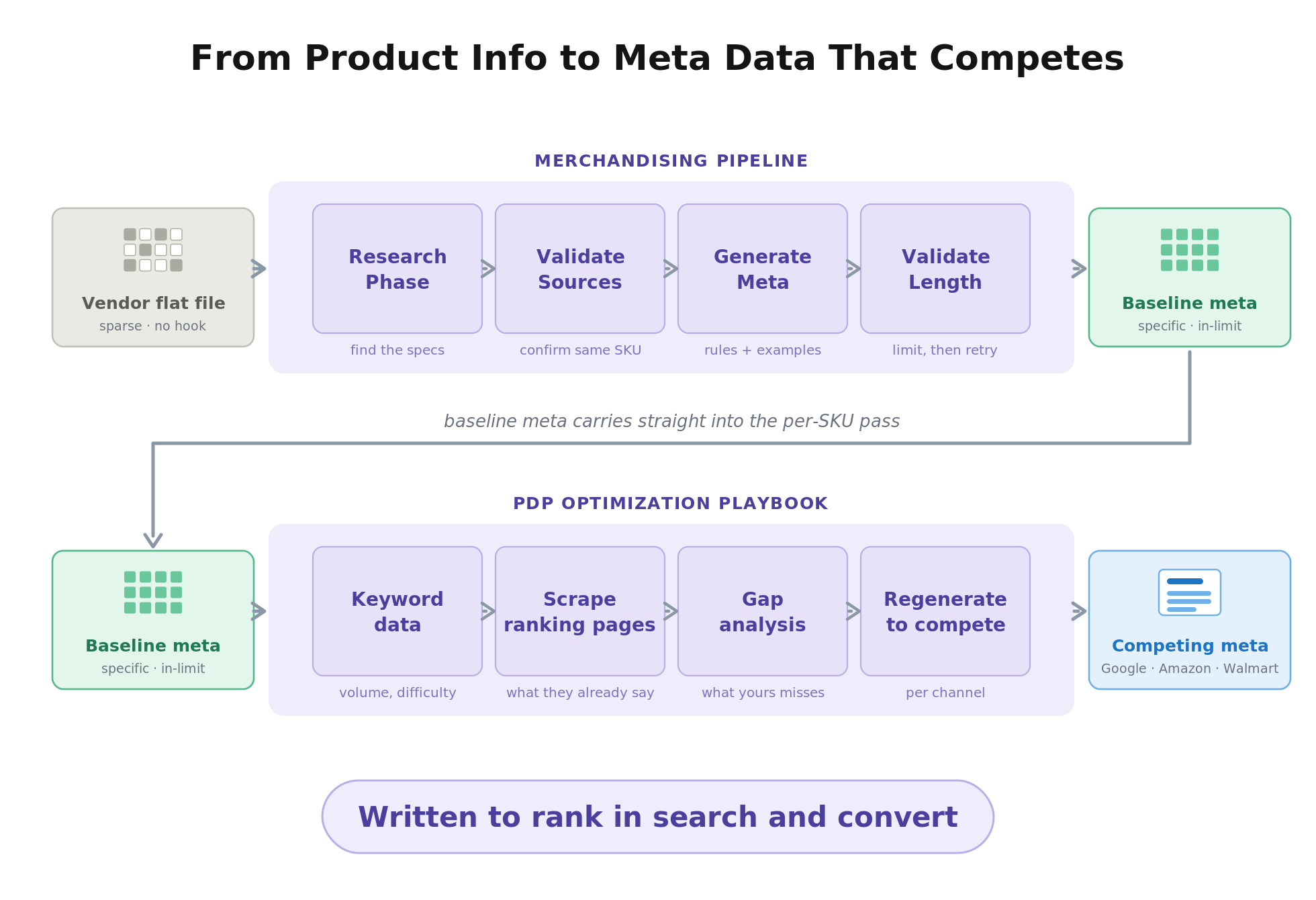
Pumice runs product meta description generation through the Merchandising Pipeline, which is the same engine that handles titles, descriptions and attributes. Metadata is a field like any other, with its own rules, its own examples and its own validation.
The run starts with research rather than writing. Using the SKU and the identifiers in your file, the pipeline pulls product data from sources you define, which for meta descriptions matters because the differentiator worth putting in the first 105 characters is usually a specification the vendor's flat file left out. A validation agent confirms the retrieved data belongs to that exact SKU before any of it reaches generation.
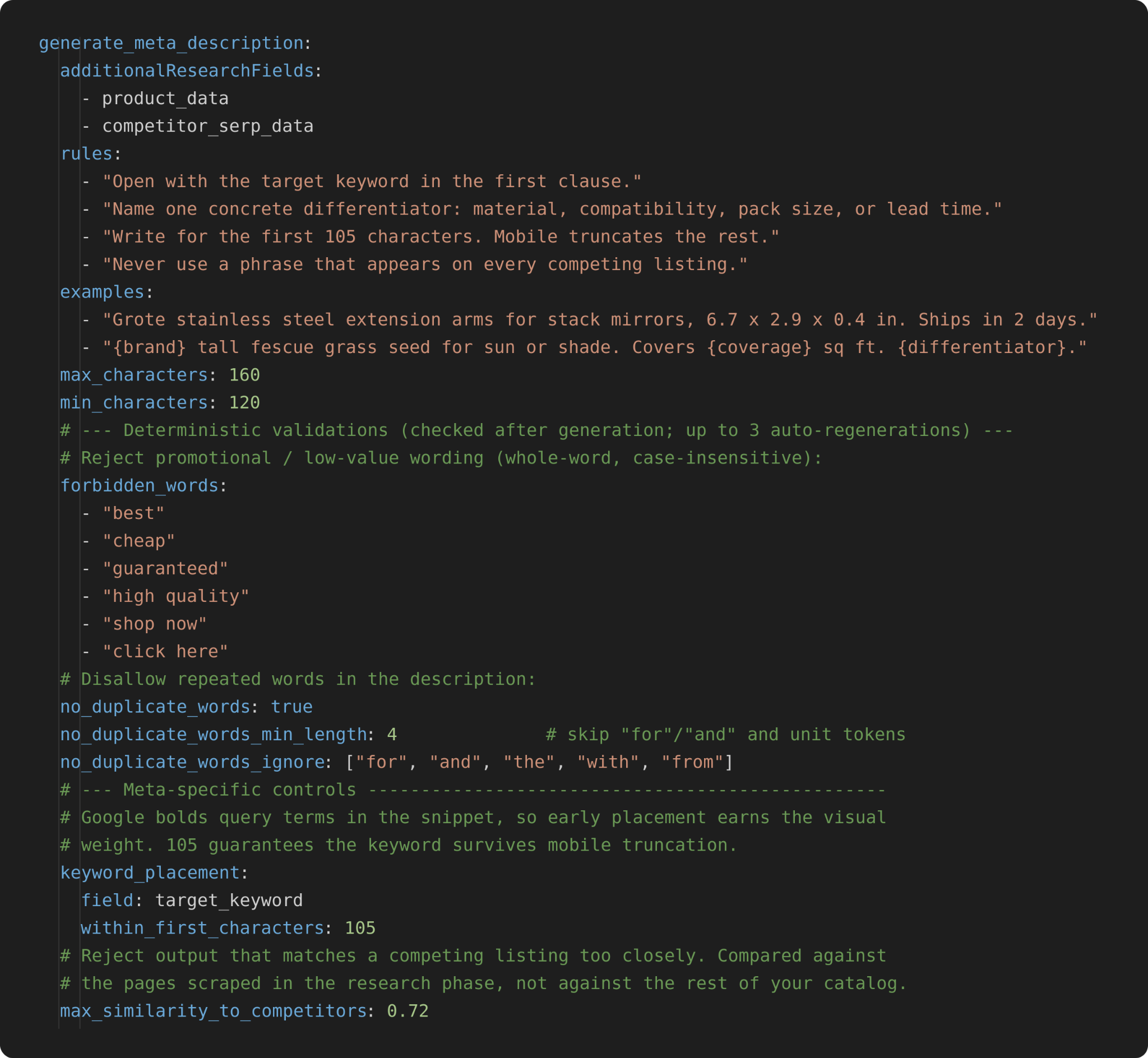
Generation then runs against three controls. Rules set the format, the required elements and the banned terms. Examples show what a correct description looks like in your categories. Validation enforces the character limit and rejects anything that misses, sending it back with the reason rather than truncating it.
For meta descriptions specifically, the rules worth writing are narrower than for a product description. Put the query term in the opening clause, name one concrete differentiator, stay inside the limit, never use a phrase that appears on every competing listing. Those four encode most of the guidance above.
Examples do the work rules cannot. A rule that says be specific is not actionable, and a model will read it as an instruction to add adjectives. Two or three finished descriptions from your own catalog, in categories you care about, teach the shape faster than a paragraph of instruction: where the differentiator sits, how you handle compatibility, whether you write dimensions in the description or leave them to the attribute table.
Validation is where metadata generation differs most from other fields. A description that runs 30 characters long is not a small problem to be trimmed later, because trimming cuts the end, and the end is usually where the generator put the reason to click. Failures go back with the specific reason and a retry, so the model rewrites to fit rather than having the tail removed by a script.
Bulk generation gets a catalog to a baseline where every product has a description that is specific, grounded and inside the limit. That is a long way ahead of a templated field and it is not the same as winning a result page.
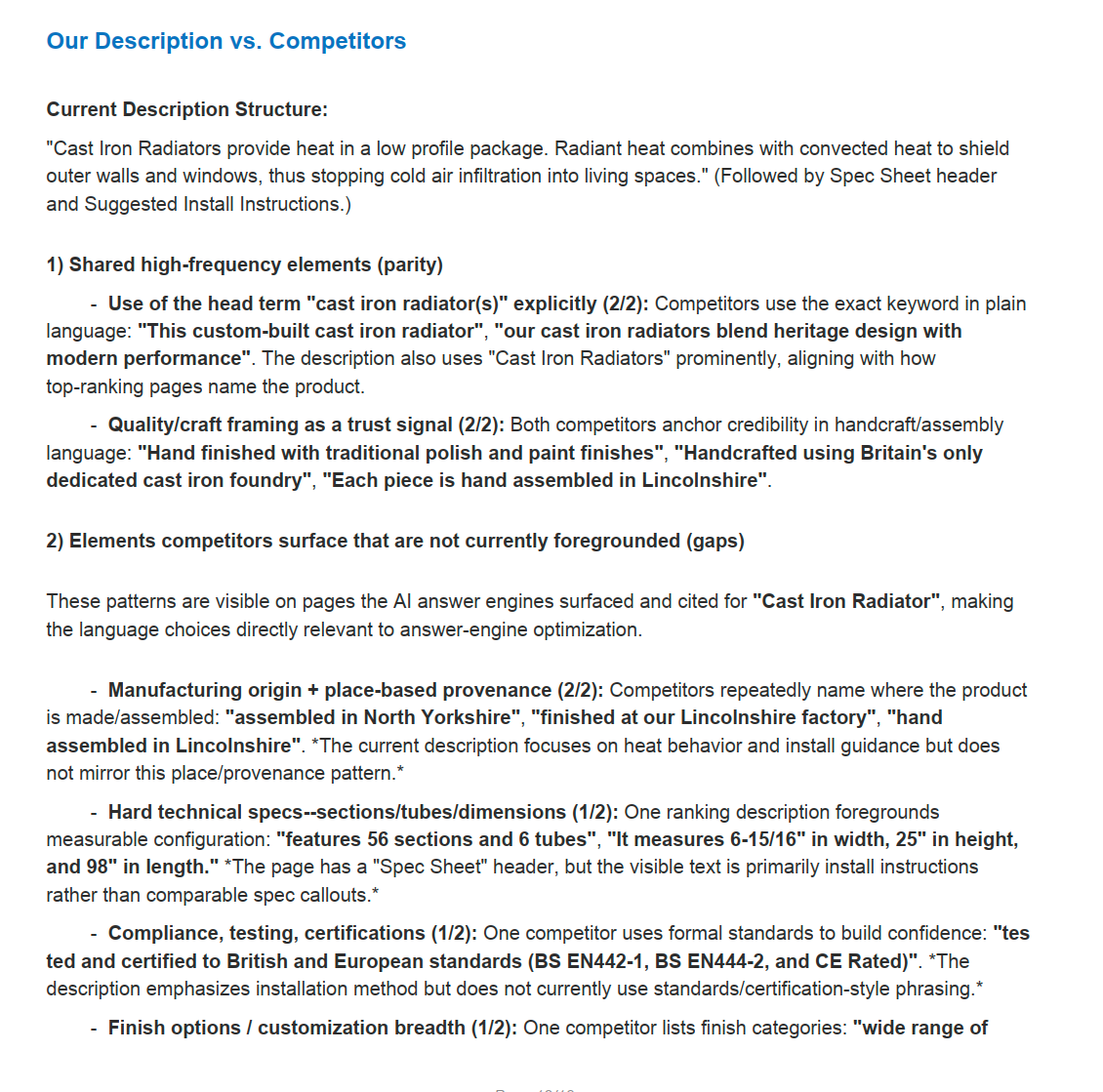
The Product Optimization Playbook is the pass that closes the SEO gap, and it is where the missing inputs from section four get supplied. You give it a SKU and a target search query. It pulls live search volume and difficulty for the term so you can confirm it is worth chasing, scrapes the pages currently ranking for it, and runs gap analysis between those pages and yours.
What comes back is a report rather than a rewritten string: which terms the ranking listings share and where they place them, what the top results are claiming that you are not, where your description sits against the pattern, and a set of specific changes with the evidence behind each one and a count of how many competitors do it.
That output then feeds back into generation. The Playbook tells you what to change, the Merchandising Pipeline applies it across the SKUs that share the pattern, and the description that ships is written against a specific result page rather than produced from a prompt. This is the difference the whole article is about, and it is a workflow difference rather than a feature.
Run it on flagship SKUs, on the pages with impressions and no clicks, and on anything where the category is competitive enough that a baseline description is not going to move. The pages with impressions and no clicks are the best place to start, because impressions prove the page already ranks well enough to be seen, which isolates the description as the thing standing between you and the click.
Most generators treat a meta description as one asset with one length. That holds if Google is your only destination, which for a catalog it usually is not.
Google truncates on rendered width around 155 to 160 characters on desktop and closer to 105 on mobile. Amazon does not use a meta description tag at all, and the equivalent surface is the listing content itself, governed by category character limits and a different set of banned terms. Walmart enforces its own attribute requirements before a listing is accepted. A wholesale marketplace expects a tone that would read as strange on a consumer storefront.
Writing one description and pasting it everywhere produces a version that is slightly wrong on every channel. Writing four separately produces four versions that drift, because the specification gets corrected in one place and not the others, and six months later nobody can say which is current.
There is also a second-order cost. Every channel you add manually multiplies the work of every future correction, so teams stop making corrections. The catalog quietly stops being current, and nobody decides to let that happen.
The version that holds is one enriched product record as the source of truth, with per channel formatting generated from it. The facts are the same everywhere. The character limits, the required attributes and the tone are not, and those are mechanical transformations once the facts are right. A correction made once propagates to every destination in the same run instead of being reapplied four times and forgotten in two.
Meta description work is unusually measurable, because the metric it moves is isolated from the metric ranking moves.
Give a bulk run 30 days before drawing conclusions and 60 before acting on them. Search Console reports with a lag, and click-through is noisy enough at low impression counts that a week of data will tell you nothing.
Every tool on this market will give you a meta description. The one worth paying for is the one that knows what the description has to beat.
A reasonable 30 day sequence: audit the pages with impressions and no clicks, because those are the ones where the description is the bottleneck. Run bulk generation across the catalog to get every product to a specific, grounded baseline. Then run the Playbook against your highest-revenue SKUs and the competitive categories, and apply what it returns.
The first two weeks fix the field. The third is where the description starts competing. Most catalogs never get past the first two, which is why a result page full of interchangeable descriptions is the normal state rather than the exception, and why a specific one is worth more than the effort it costs.
Pumice's Product Optimization Playbook pulls the listings currently ranking for your target query, compares them against yours, and returns the specific changes to make. Pick a product that has impressions and no clicks and see the gap analysis. Free to try, no credit card required.
A tool that writes the meta description tag for product pages, usually in bulk across a catalog rather than one page at a time. It pulls from product titles, attributes and descriptions. The better ones also take keyword data and the live result page as inputs, so the output is written to compete rather than just to fill the field.
Scale and source data. A regular generator handles one page at a time from content you paste in. A product version runs across thousands of SKUs, pulls from structured product data, and has to cope with vendor records that arrive incomplete.
They write from the product record and nothing else. No keyword data, no view of the listings currently ranking, no check on whether Google is likely to override the result for being too generic. The output is plausible, which is why the problem goes unnoticed until a year of flat click-through.
Two things. Pumice takes live SERP and competitor data as generation inputs through the Optimization Playbook, which is a second product Describely does not have. And Pumice generates per channel from one record rather than syncing a single version to a storefront.
Google truncates on rendered width, roughly 155 to 160 characters on desktop and around 105 on mobile. Amazon has no meta description tag and applies category limits to listing content instead. Walmart enforces its own attribute requirements. Treat them as separate outputs.
Yes. The Merchandising Pipeline runs catalog-wide, thousands per job, with validation on every row and a retry on anything that fails the character limit. Rows that cannot be completed are flagged rather than dropped.
Yes. A CSV or feed is the normal starting point. Where the incoming data is too thin to write a specific description, the research phase fills the gap from the vendor source before generation runs.


.png)