A regional janitorial supplier needs forty cases of industrial degreaser delivered to one distribution center on net 30 terms. They already know the product. What they are trying to work out, from a page of search results, is whether your minimum order is four cases or four hundred (and what pricing scales to), how many gallons each container holds, and what types of metal it works on.
That is the behavior SEO for wholesale distributors has to serve, and it is not the behavior a consumer product page was built for. A distributor buyer is not deciding whether they want the product. They are running margin + volume math. Case pack, unit weight, tier break, lead time and payment terms are the entire evaluation, and most wholesale catalogs publish none of it anywhere a search engine can read.
The failure this produces does not look like an SEO problem from the inside. Product pages carry a manufacturer paragraph that four competing distributors publish word for word. Pricing sits behind a trade account login. Minimum order quantity is a field in the ERP and nowhere else. The catalog is online, indexed, and functionally invisible to a buyer searching for a case of something.
Cleaning this up is not easy. Publish the numbers a reseller needs to run margin math. Write PDPs around the questions buyers ask instead of the labels your merchandising team uses internally. Build spec sheets that align with the shopping behavior of your customers. Then do all of that across a catalog with tens of thousands of SKUs in it, which is the part that stops being a copywriting job and becomes a pipeline.
✂️ Definition
What is SEO for wholesale distributors?
SEO for wholesale distributors is the practice of optimizing a B2B wholesale supplier's website so that product pages, category pages, and trade account pages rank for the queries reseller buyers run. It differs from ecommerce SEO because the buyer is purchasing to resell rather than to use, which makes minimum order quantity, case pack, volume pricing tiers, and payment terms the deciding information on the page. The work covers wholesale keyword research, publishing MOQ and tier pricing on indexable pages, enriching manufacturer-supplied product copy, and distributing one consistent catalog across wholesale marketplaces.
Areas we will focus
Reseller buyers search with qualifiers/goals different from standard ecommerce buyers. Bulk, case, MOQ, trade pricing and attributes all filter your traffic down to people who buy in volume.
Minimum order quantity and volume pricing tiers are on-page SEO decisions, not sales decisions. Gating them removes the exact text that would have matched the query.
Manufacturer-supplied copy is a structural disadvantage, because every competing distributor carrying that SKU publishes the identical paragraph.
Doing this across tens of thousands of SKUs is a real lift. Pumice ai agents automate this flow.
AI answer engines cite the same completeness that wins organic. A product record with a real attribute table and answered questions is quotable. A two-line description is not.
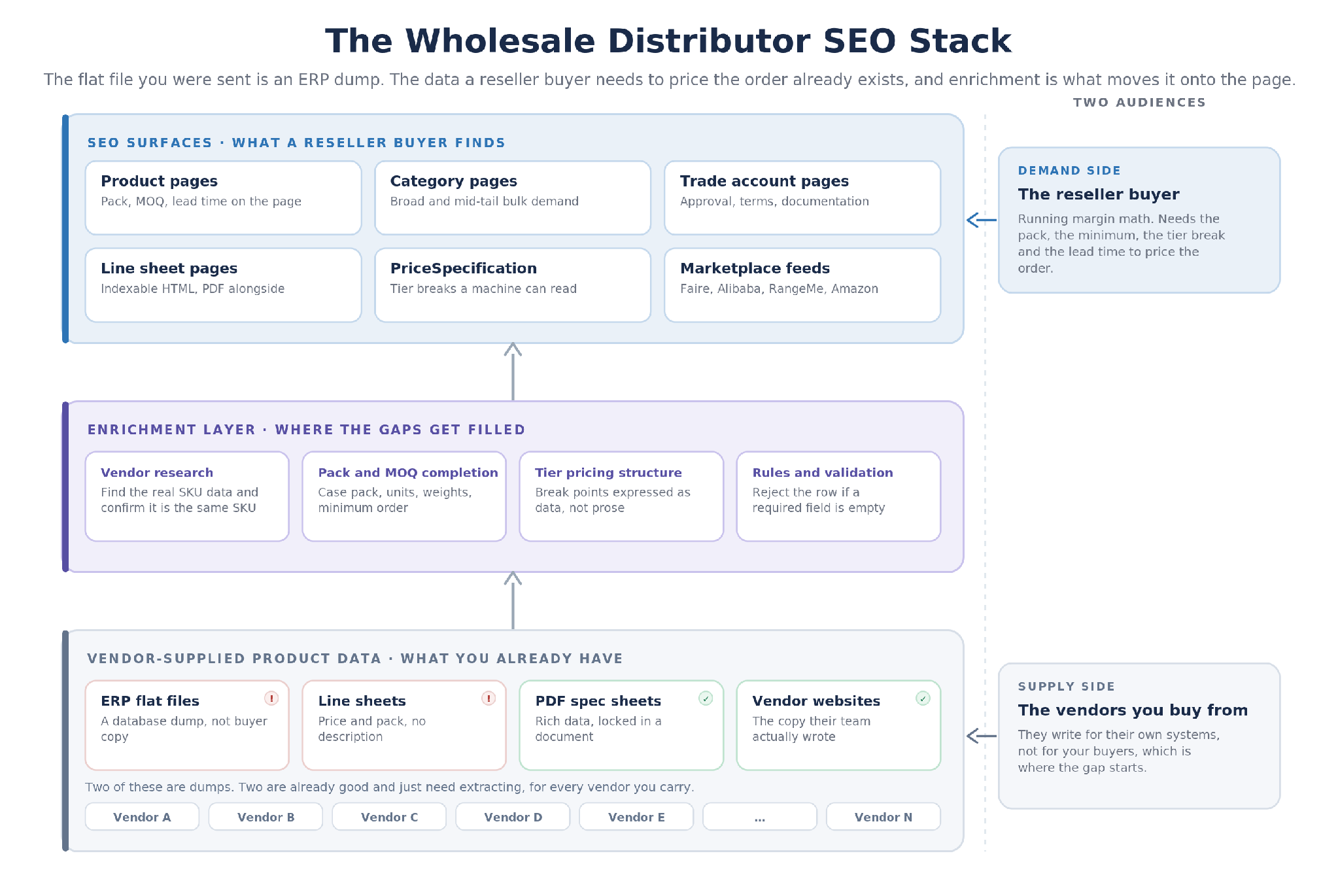
The wholesale distributor SEO workflow
Why SEO strategies for a Wholesale Business are different than normal ecom
Wholesale companies share most of their surface area with ecommerce. Product pages, category pages, search, checkout. Three differences change what the on-page SEO work actually focuses on.
Your Buyer Is Reselling, Not Using
A b2c product page is written to make one person want the product. A reselling buyer is focused on a bit more. They are judging whether the product will sell through to their own customers, and they are working out whether the economics make sense. Pack configuration, minimum order, where the price breaks, lead time, whether you drop ship, and whether a pallet can go to their distribution center rather than a storefront all sit in that second layer. A page that only does the first job leaves them guessing on the second.
Every one of those is a question the buyer will otherwise send you an email to ask, which means every one of them is a query somebody is typing into Google right now. Answering them on the page is simultaneously a conversion and ranking optimization.
The Manufacturer Copy Trap, Multiplied
As you probably know already, most vendors send you sparse product data in flat files: a short title, two sentences of description, a partial attribute set, one image. That is weak on its own, but what makes it structurally fatal for a distributor is that every other distributor carrying the SKU publishes from the same sparse flat files. Search engines have to choose one of you, and the tiebreaker is not going to favor the distributor who changed nothing.
The Marketplace Layer
Third party marketplaces (Faire, Amazon) are incredibly useful sales channels that allow you to leverage their buyer pool for your SKUs. The key concept to consider when using these platforms is that the same issues you have with your own SEO/content completeness will persist with them. If you’re unable to create listings that attract qualified buyers and convert you’ll be wasting your time. These platforms will not solve your visibility issues.
Wholesale-Specific Keyword Research
Wholesale keyword research fails in a predictable way. Teams pull the head terms from Google's keyword planner for their categories, find them dominated by consumer retail, conclude search does not work for wholesale, and stop. The head terms are the wrong focus area considering how wholesale buyers differ.
The Query Patterns Wholesale Buyers Actually Run
Reseller buyers self-select with qualifiers. The recurring patterns are wholesale plus the product, bulk plus the product, buy the product in bulk, the product plus wholesale supplier, the product plus distributor near me, and case of the product. Each qualifier strips the consumer traffic out of the term before it reaches you, which is why the search volume looks disappointing and the conversion rate does not.
MOQ and Terms Are Keyword Territory
The higher-value list is the one almost nothing ranks for: MOQ plus the product, trade pricing plus the product, net 30 wholesale plus the product, and wholesale account plus the category. Competition on these is close to zero, and the reason is circular. The answers live behind trade account logins across the entire industry, so no page exists that can rank for them.
Build the keyword strategy from the qualified terms up rather than the head terms down. A distributor who owns forty MOQ and trade-terms queries in their categories is reaching more buyers than one ranking on page three for a head term that mostly serves consumers.
On-Page SEO for Wholesale Distributor Product and Category Pages
When looking at the full scope of search optimization work for distributors, this is by far the most important focus area.
Product Titles That Carry the Bulk Qualifier
A vendor title is written for the vendor's own catalog management. It carries internal SKU codes, puts the brand wherever the ERP export happened to put it, and leaves out the attributes a buyer searches on. A workable wholesale title names the brand, the product, the differentiating attribute, and the pack configuration, in a fixed order, inside your character limit. The pack configuration is the part distributors leave out and the part that separates a wholesale result from a retail one.
A high end title and sub title for a ranking wholesale product
Descriptions Written for Margin Math
Case pack size, units per case, unit weight, dimensional weight, lead time from order to dock, and reorder cadence. A description that carries those six things answers the email a buyer would otherwise send, and gives an answer engine something specific to quote. A description that carries adjectives about quality and heritage answers nothing and gets quoted nowhere.
The test is whether a buyer could price the order without contacting you. If they can, the page has done its job twice, because the same specificity that lets them calculate margin is what a search engine reads as depth on a page four competitors filled with the same vendor paragraph.
Publish MOQ and Volume Tiers Instead of Gating Them
Minimum order quantity behind a login is the single most common self-inflicted ranking problem in wholesale. The query is MOQ plus the product name. If the number is not in the HTML, there is nothing to match, and the buyer goes to whoever did publish it.
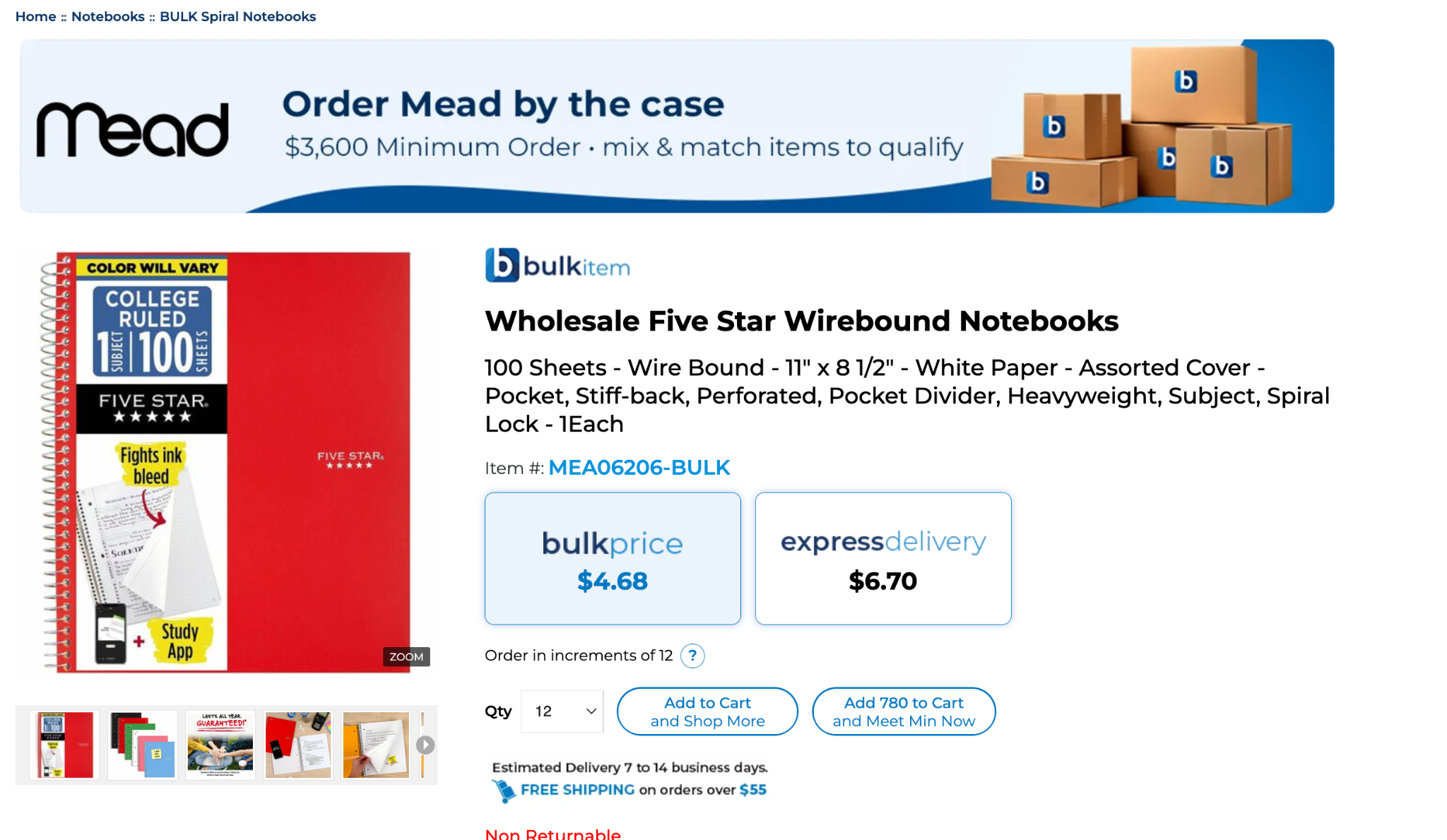
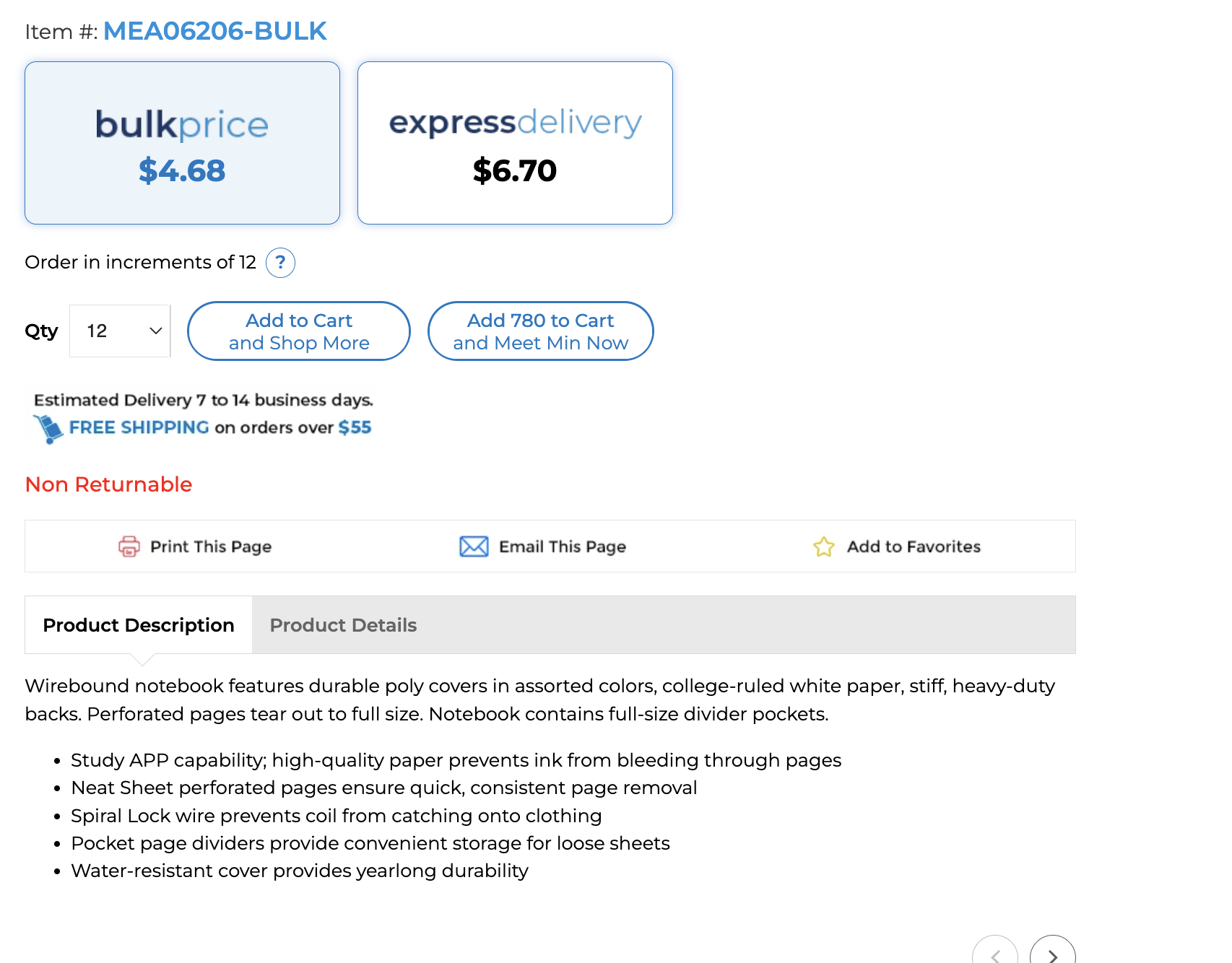
Quantity information, bulk pricing, and shipping information directly listed above the fold on the product page
The objection is real and worth answering directly: publishing pricing shows competitors your pricing. The workable split is to publish the tier structure and the break points, which is what buyers search on, and gate the account-specific net price, which is what your competitors want. A page that says the minimum is four cases and the price breaks at 12, 48 and 144 has given away nothing a rep would not say on a first call, and has become the only page in the category that can rank for the query.
Schema for Volume Pricing
Product and Offer schema are the baseline. The piece wholesale catalogs skip is PriceSpecification with eligibleQuantity, which expresses a tier break in a form a machine can read. It is the difference between a price that a search engine has to infer from page text and a price structure it can parse.
Schema completeness is capped by attribute completeness, which is the loop running through this entire playbook. You cannot mark up a case pack you never recorded. Fix the underlying product data and the structured data, the faceted filters, and the marketplace feeds all improve from the same change.
Three decisions come up in all our wholesale distributor SEO work, and the gated only option loses all three.
Decision
The open version
The gated version
What search sees
Minimum order quantity
MOQ published on product and category pages
MOQ visible only after trade account approval
Only the open version has text that can match an MOQ query
Volume pricing
Tier structure and break points on the page, account net price gated
All pricing behind the login
Only the open version can carry PriceSpecification schema
Wholesale marketplaces
Your own site plus marketplace listings, generated from one catalog
Marketplace listings only
Only the open version accrues ranking equity you keep if a channel closes
Website Structure, Categories, and Trade-Account Pages
Category pages are where wholesale distributors capture broad and mid-tail demand, and most are named after internal merchandising labels rather than anything a buyer types. “Wholesale wirebound notebooks” and “Bulk copy paper” are queries. “Foodservice Division” is an org chart.
The trade account registration page is the one most distributors waste. It is usually a bare form behind a headline, which gives a search engine nothing, and it is the page buyers searching wholesale account plus your category are trying to find. Give it real copy: what the approval takes, how long it takes, what documentation you need, which terms you extend and at what volume, and what happens on a first order. Shopify B2B, WooCommerce B2B and BigCommerce B2B all gate this page by default, so on every one of those stacks it is a deliberate change rather than a setting.
Net terms and financing deserve their own click through page for the same reason. Net 30 wholesale plus a category is a real query with a real buyer behind it and almost no keyword ranking competition.
Line sheets are the last one. A line sheet delivered as a gated PDF ranks for nothing. The same line sheet published as an indexable HTML page, with the PDF available alongside it, is a category page with pricing structure on it.
Wholesale Marketplaces as Parallel Discovery Channels
Reseller buyers do not only search Google. They browse marketplaces (Faire, RangeMe, Amazon Business) built for exactly this transaction, and after the consolidation described above the surviving set is short enough to name.
Each one has its own product data rules, character limits, required attributes and category tree, which is why most distributors end up with five slightly different versions of the same catalog and no confident answer about which is current.
That is a data problem not a listing quality problem, and it has one correct shape. Maintain one enriched catalog as the source of truth, and generate each channel's format from it. A fix made once propagates to your own product pages, to Faire, and to Amazon Business at the same time, instead of being reapplied five times and forgotten in two places. It is also the version that survives a channel closing, which the last three years suggest is worth planning for.
Content Strategy, Local, and Technical SEO for Wholesale Websites
Content That Reaches Reseller Buyers
Long form blog content can be incredibly useful. “How to source a category wholesale”, “what MOQ ranges are normal and why they vary”, “how wholesale licensing and resale certificates work”, and honest comparisons of pack configurations for different retail formats. These are search queries you can use to get buyers at an early step in the buying process on to your site and into your funnel. We see these work incredibly well to build brand visibility and email lists of down the road buyers.
This blog gets almost 4k monthly visitors and uses internal links to drive traffic downstream
Local SEO for Distribution Centers
Wholesale distributors with physical distribution centers have a local advantage they usually ignore. Claim and complete a Google Business Profile for each one, with the categories served and the delivery radius stated. Build a page per location that names the territory in the language buyers use. Product plus distributor near me is a live query pattern in most wholesale categories, and it lands on location pages or nowhere.
Technical Work Specific to Wholesale Catalogs
Three things matter more here than on a b2c ecom site. Faceted navigation needs a deliberate policy for quantity and pack filters, because pack size multiplies your URL count fast. Unit-pack variants of one SKU need a canonical strategy, or the single-unit page, the case page and the pallet page all compete for the same query. Sitemaps should be segmented by page type so that indexation problems can be read per surface rather than as one number.
Automate Wholesale Distributor SEO and AEO With Pumice
Everything above is a serious lift, and it gets heavier every time you onboard a vendor and inherit another flat file. Pumice is a SKU onboarding automation platform focused on the work between a vendor-provided SKU and a fully enriched product page that ranks and converts qualified buyers. Our ai agents research, retrieve, and write product listings that follow your exact copy guidelines and rules.
We have two different starting places depending on the initial quality of your product data.
Method 1: Merchandising Pipeline When Vendor Data Is Sparse
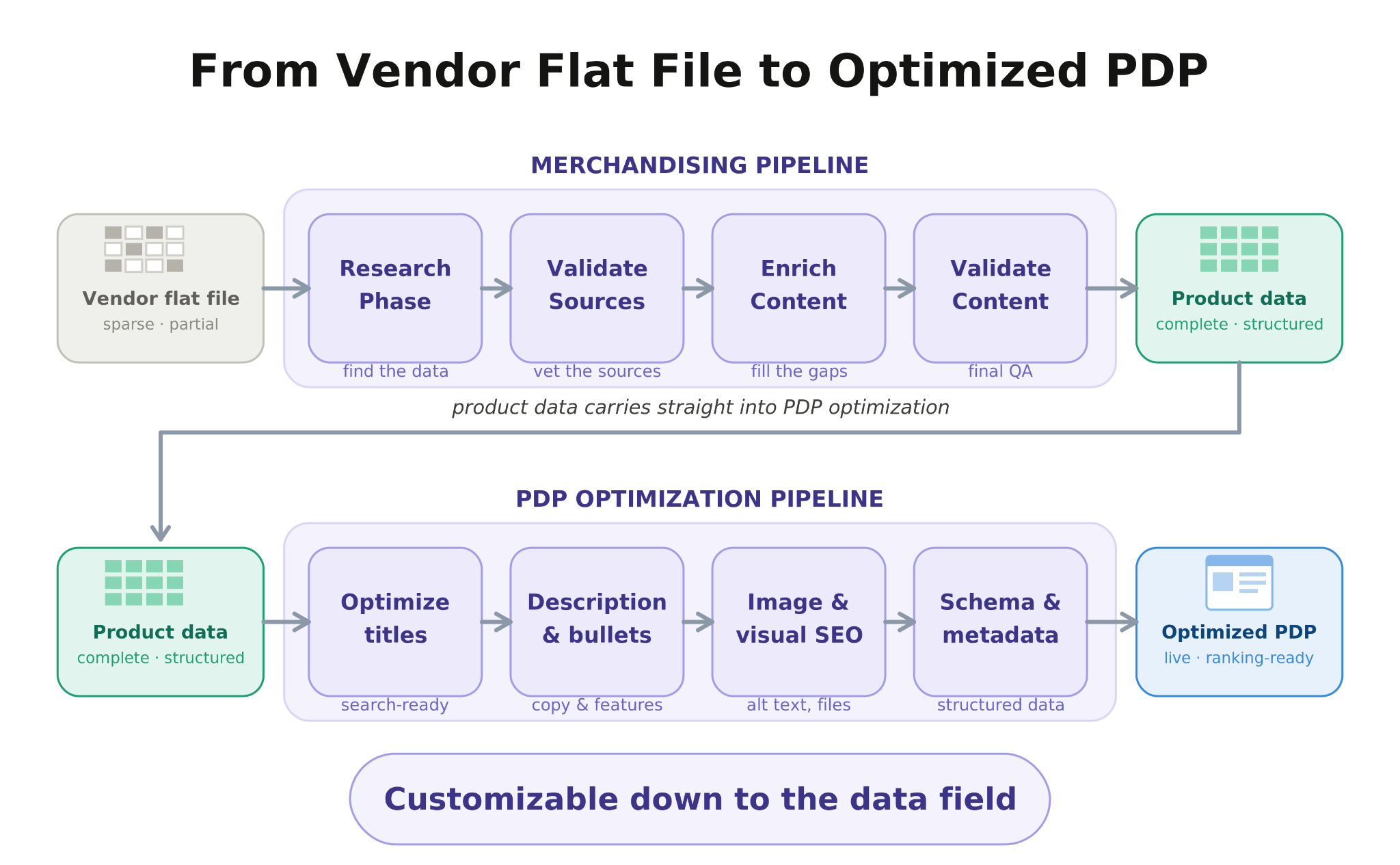
Start here when your product records are too thin to optimize, which for a wholesale distributor is the normal state when receiving flat files. The pipeline researches each product against manufacturer and vendor sources, validates that the data it found belongs to that exact SKU, then generates enriched titles, descriptions, attribute sets and bullet points against your rules. It runs catalog-wide, thousands of SKUs per job, rather than one product at a time.
Method 2: PDP Playbook for Optimization of Product Pages
Move here when your product records already carry complete data and you want to tweak them for SEO and AEO. The Product Optimization Playbook analyzes the pages ranking for your target query, compares them against your listing, and returns a specific playbook of changes to the title, description, attributes and on-page structure. This is the per-SKU pass for flagship products and high-volume categories, run after enrichment rather than instead of it.
[Merchandising Pipeline] Step 1: Research Phase for Vendor Data Augmentation
The pipeline starts at the research phase, focused entirely on increasing the amount of data we hold for a specific SKU. We cannot enrich a SKU without real data, or we end up with hallucinated junk that causes returns and wrong pack quantities. Using the existing record, such as the name and the manufacturer part number, Pumice searches sources you define, which keeps you in control of where the data comes from. The ai scraper extracts what you specify: description, attribute table, case pack and unit dimensions, certifications, images. A validation agent then confirms the extracted data belongs to that exact SKU. That check carries a lot of the value here, because a catalog full of nearly identical pack variants is exactly where an ungrounded tool writes the 24-count description onto the 12-count product.
☞️ Field Note
Start from the vendor's website, not the flat file they sent you.
The vendor flat file you were sent is almost always an ERP export, stripped down to what the vendor's system needed rather than what a buyer needs. The vendor's own website usually carries a far better version, written by their marketing team. Point the research step at the vendor site on ingestion and you start from their good copy instead of their database dump.
You can also hand the research step any PDF catalogs or spec sheets a vendor has sent you. In production this is often the strongest source, because it comes straight from the manufacturer and carries the pack configurations and certifications the website leaves out.
[Merchandising Pipeline] Step 2: Generate Product Pages That Follow Your Exact Rules, Guidelines, and Schema
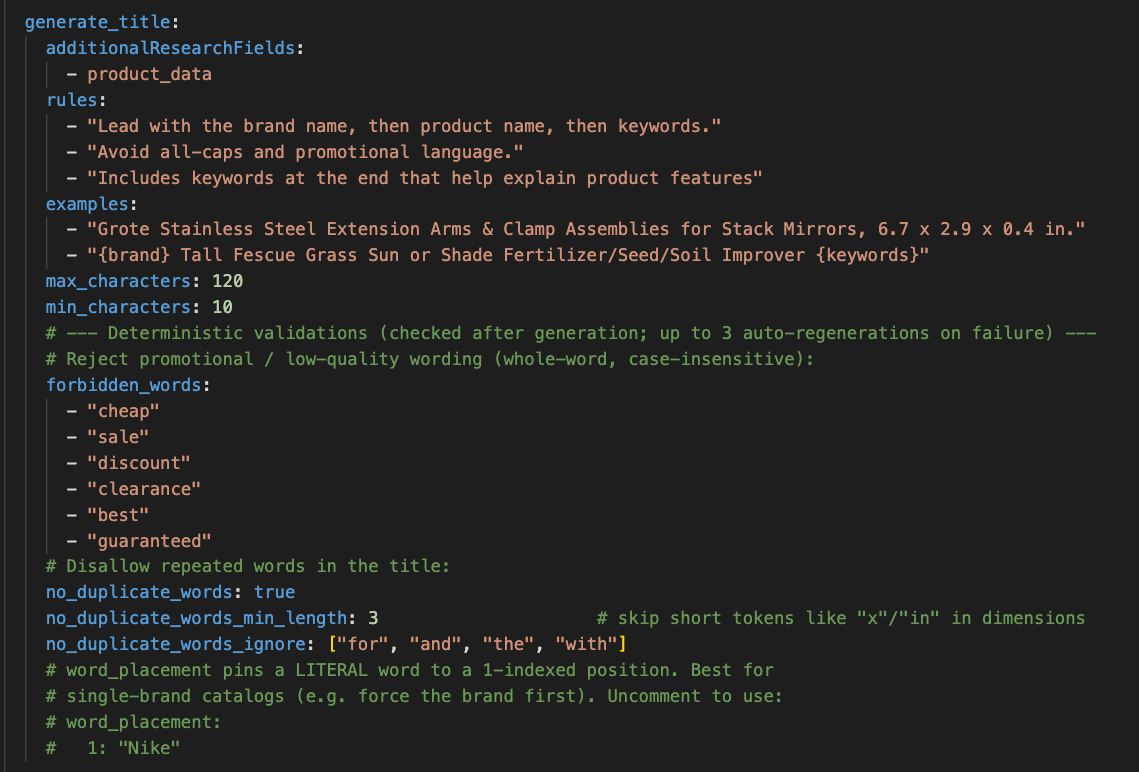
With the SKU research complete, our generation agents write new copy following provided rules, examples and validations. Each field (title, bullet, description and so on) can hold its own set of these, which allows for per field refinement.
Rules. Natural-language instructions the agents follow during generation. For a wholesale distributor these are where your pack and terms standards get enforced: lead with brand and model, state the pack configuration in the title, include the minimum order and tier break points in the description, list required certifications.
Examples. Sample listings you consider correct. A rule like use relevant keywords is vague on its own, and examples teach the agents what good looks like in your categories specifically, including how you write a pack configuration.
Validation. A checker agent reads the generated listing against your rules and regenerates anything that fails, which is what lets the pipeline run unattended across thousands of SKUs. The most valuable validations here are required fields: reject the row if case pack, MOQ or certification is empty.
The Pumice rules configuration for title generation with rules, examples, and validations
[PDP Playbook] Step 3: Optimize Product Listings for SEO and Search Visibility
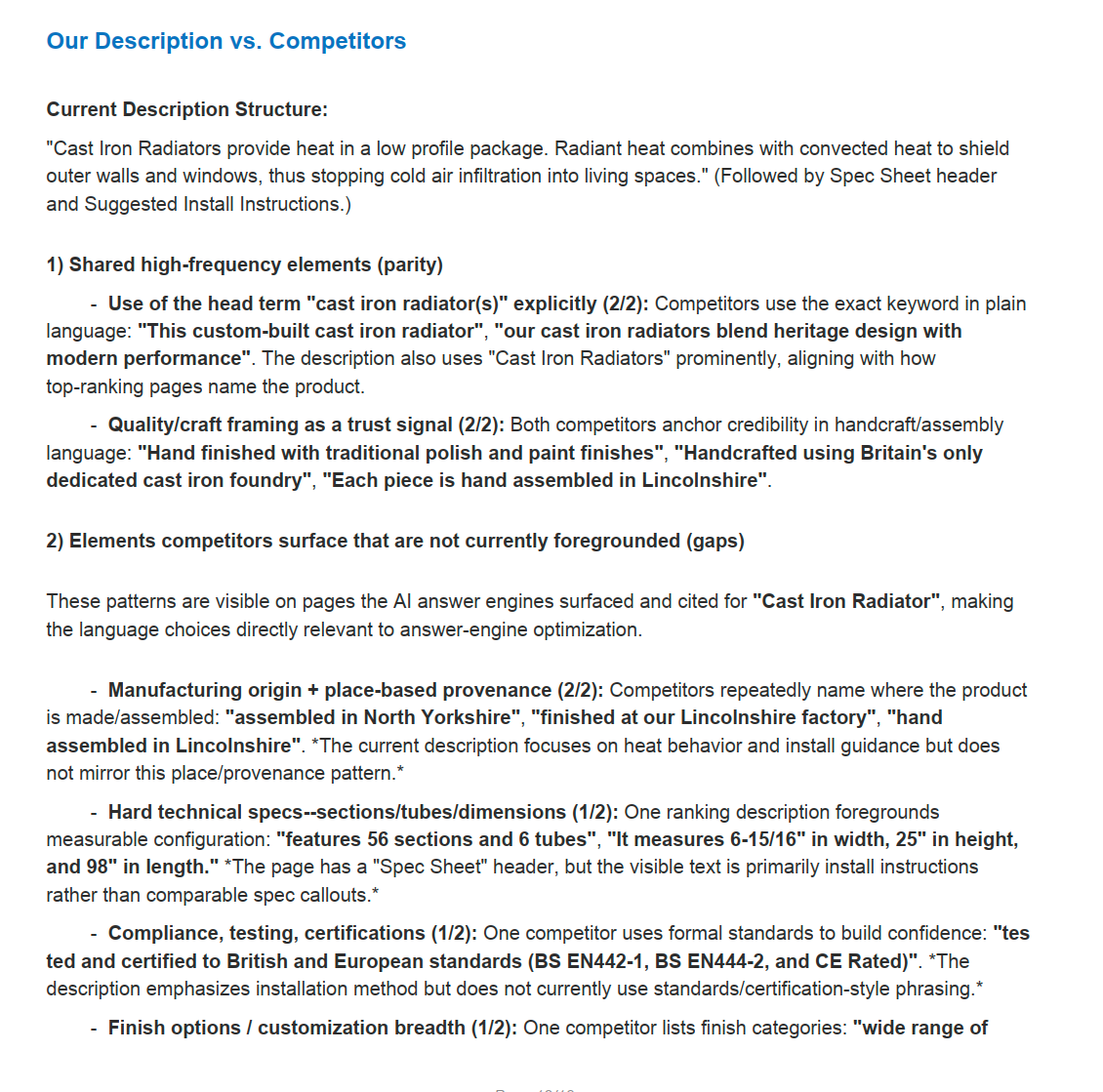
With the catalog enriched, the Playbook does the focused pass on the SKUs that carry disproportionate revenue. It scrapes the pages competing for your target keyword, runs the gap analysis, and returns a shareable report with the specific changes to make. Run it on flagship SKUs and on category pages that should rank higher than they do.
A page of the Pumice Playbook report showing the gap analysis between a wholesale product page and the competitor pages currently ranking for its target query.
One Catalog, Every Channel
Because the enriched record is the source of truth rather than any one channel's copy of it, the same output reformats per destination: your own product pages, Faire, Alibaba, RangeMe, Amazon Business. Character limits differ per channel and the underlying facts do not.
Why the Same Pipeline Serves AEO Search Traffic
The product data that makes a page rank is the same product data an answer engine quotes. A complete attribute table answers a pack configuration question directly. Question and answer blocks generated from product data map onto what buyers type into ChatGPT, Perplexity and Google AI Overviews. Distributors who close their listing gaps for SEO get AI visibility as a side effect, and distributors who leave listings at two vendor sentences are absent from both surfaces for the same reason.
Turn Your Vendor Flat Files Into Product Pages That Rank
Pumice.ai runs the full wholesale merchandising pipeline described in this article: catalog ingest, vendor and manufacturer research, rules-driven title and description generation with pack configuration and MOQ enforced, and validation against your category rules. Free to try, no credit card required. Bring a CSV of SKUs where the descriptions are still your vendor's two sentences and see what comes back.
Revenue from organic search first. Everything else on this list is a leading indicator for it, and any SEO program that cannot connect its work to orders is going to lose its budget in the second year regardless of how the rankings look.
Trade account applications and approvals from organic, which is the clearest signal that qualified reseller buyers are arriving.
Line sheet downloads and wholesale RFQ submissions, attributed back to the landing page and the query that produced them.
Rankings and organic traffic on category pages, tracked separately from product pages because they answer different demand.
MOQ and case pack coverage across the catalog, meaning the share of SKUs where those fields are populated and published. This moves before the rankings do.
Give structural changes 90 days before drawing conclusions. Indexation and schema changes in particular take time to propagate across a large wholesale catalog.
Conclusion: A 30-Day Wholesale SEO Plan
The wholesale distributors who win search are rarely the ones with the biggest catalogs. They are the ones whose pages answer the question a reseller is actually asking, which is almost never what the product is and almost always what it costs at volume and how much of it they have to take.
Week one, publish minimum order quantity and volume tier structure on your top 20 category pages. Week two, rewrite the trade account page so it explains the approval, the terms and the timeline instead of just collecting an email, and give net terms its own page. Week three, name your categories after the queries buyers type and add PriceSpecification schema to the offers that have tiers. Week four, run enrichment across the catalog and the Playbook against your highest-revenue SKUs.
The first three weeks are decisions. The fourth is the one that needs a pipeline, because vendor data does not improve on its own and no team reviews twenty thousand SKUs by hand.
Optimize Your Best Wholesale Listings in Minutes
Pumice.ai's Product Optimization Playbook shows you exactly how the pages beating you are structured, with data driven insights you can act on directly. Pick a flagship SKU or a category page that underperforms and see the gap analysis. Free to try today.
How long does SEO for wholesale distributors take to work?
Qualified long-tail terms move fastest. MOQ, trade pricing and net terms queries have so little competition that a page answering them can rank inside 60 to 90 days. Category-level terms usually take 4 to 8 months. Catalog-wide enrichment shows up as a compounding lift rather than a step change, because it improves thousands of pages that each pick up a few long-tail queries. Local seo support results are usually much much faster.
How is wholesale distributor SEO different from ecommerce SEO?
The buyer is purchasing to resell rather than to use, which changes what has to be on the page. Case pack, minimum order quantity, volume tier breaks, lead time and payment terms decide the sale, and none of them appear on a consumer product page. Wholesale catalogs also inherit their product copy from vendors rather than writing it, so the duplicate content problem is structural rather than occasional.
Common seo mistakes we see:
poorly defined PDPs - sparse titles, poor descriptions, no technical details listed in attributes section.
poor alignment of category pages to top level keywords or multiple categories targeting the same top level keyword.
No link building: High quality backlinks greatly increase your ability to rank pages. Industry directories are a great place to start.
No keyword research focus on qualified leads: Stop targeting keywords that don't drive revenue.
No mobile optimization for informational pages. These are not purchase focused pages, people do not purchase from these.
How do I better help Google understand my site layout?
Technical optimizations like clearly structured sitemaps help search engines understand how your catalog is outlined.
Internal linking in a "funnel format" makes it easier to understand what pages are category level, and which are PDPs. Content marketing (blogs, informational content) funneling to category pages with a PDP schema.
Should minimum order quantity be visible or gated?
Visible. MOQ behind a login cannot match a query that names it, and buyers searching for a minimum order are the most qualified traffic a wholesale distributor gets. Publish the minimum and the tier break points, and gate the account-specific net price if competitive exposure is the concern. That split gives away nothing a sales rep would withhold on a first call.
How do wholesale marketplaces fit alongside your own site?
As parallel channels fed from the same catalog, not as a replacement for it. Faire, Alibaba, RangeMe, IndieMe and Amazon Business each reach buyers who browse rather than search, and each has its own data rules. The risk in treating a marketplace as your primary channel is that Handshake, Tundra and Abound all closed or were absorbed between 2023 and 2026. Ranking equity on a domain you own does not evaporate when a platform does.
Can wholesale companies SEO be handled in-house?
The structural work can. Naming categories after buyer queries, building a real trade account page, publishing MOQ and tier structure, and claiming a Google Business Profile per distribution center are decisions rather than projects. What resists an in-house team is catalog-wide enrichment, because rewriting twenty thousand vendor descriptions is not a problem you solve by hiring one more person.
How does AI search change wholesale product discovery?
It rewards the same completeness organic already rewarded, which makes the work double-counted rather than doubled. Answer engines quote filled-in specifications, valid structured data and questions already answered on the page. A wholesale listing with a full attribute table and a stated case pack gets cited. One with two vendor sentences gives a model nothing to work with.





.png)