Point your phone at an item and an AI eBay lister gives you back a title, a set of item specifics, a category and a price pulled from what the thing recently sold for. 30 seconds, start to finish. For a table of estate-sale inventory that is a real saving, and the listings come out looking professional.
Then you run two hundred SKUs through it. Every listing is accurate. The titles read well, the specifics are filled in, the categories are right. Three weeks later you open Seller Hub and the whole batch has impressions in the low hundreds, and the two items that sold were the two where you happened to write the title yourself.
Nothing malfunctioned. The listings were written from the item, but they were never written to sell. A photograph tells a model what an object is. It carries no information about the words buyers type into eBay, about what the listings already winning that category put in their titles, or about which item specifics that category lets shoppers filter on. Those are separate inputs, and no amount of accuracy about the object supplies them.
So the useful question is not how fast a listing tool turns a photo into a listing. It is what how the listing performs, and if the ai generated listings can outperform manually written ones. This article is about the second one, and it is written for a particular reader: the seller putting hundreds or thousands of repeatable SKUs on eBay that need to rank well, and sell well.
Key Takeaways
An AI eBay lister generates listing content automatically. The three categories on the market solve very different problems, and picking the wrong one wastes months.
Speed and accuracy are not the same as performance. A listing can be completely correct about the item and still never surface in search.
eBay's Best Match scores title relevance to real buyer queries, item-specifics completeness, category correctness, price and sell-through history. A photo supplies none of those inputs.
Listings that rank are written from four data sources: eBay keyword demand, the competitor listings already winning the category, sold comps, and the manufacturer's own product data.
eBay's native Magical Listing is app-only and aimed at private and personal sellers, with business accounts still pending, so catalog sellers cannot use it even if they want to.
Pumice is built for catalog-scale sellers: one enriched product record, formatted for eBay, Amazon and Walmart. Thrift and estate flippers are better served by the photo tools.
✂️ The short answer
What is an AI eBay lister?
An AI eBay lister is software that generates eBay listing content automatically, producing the title, item specifics, category, description and often a suggested price without a seller writing each field by hand. There are three distinct categories. eBay's own native listing AI creates a draft from a photo inside the mobile app. Photo-to-listing reseller tools identify an item from images and price it against recent sold comps, which suits one-of-a-kind inventory. Catalog-scale listers work from a product record rather than a photograph, generating listings for repeatable SKUs from vendor data, keyword demand and competitor listings, which suits brands and distributors publishing at volume and across several marketplaces. The category a seller needs depends less on the volume of listings than on whether the inventory is unique or repeatable.
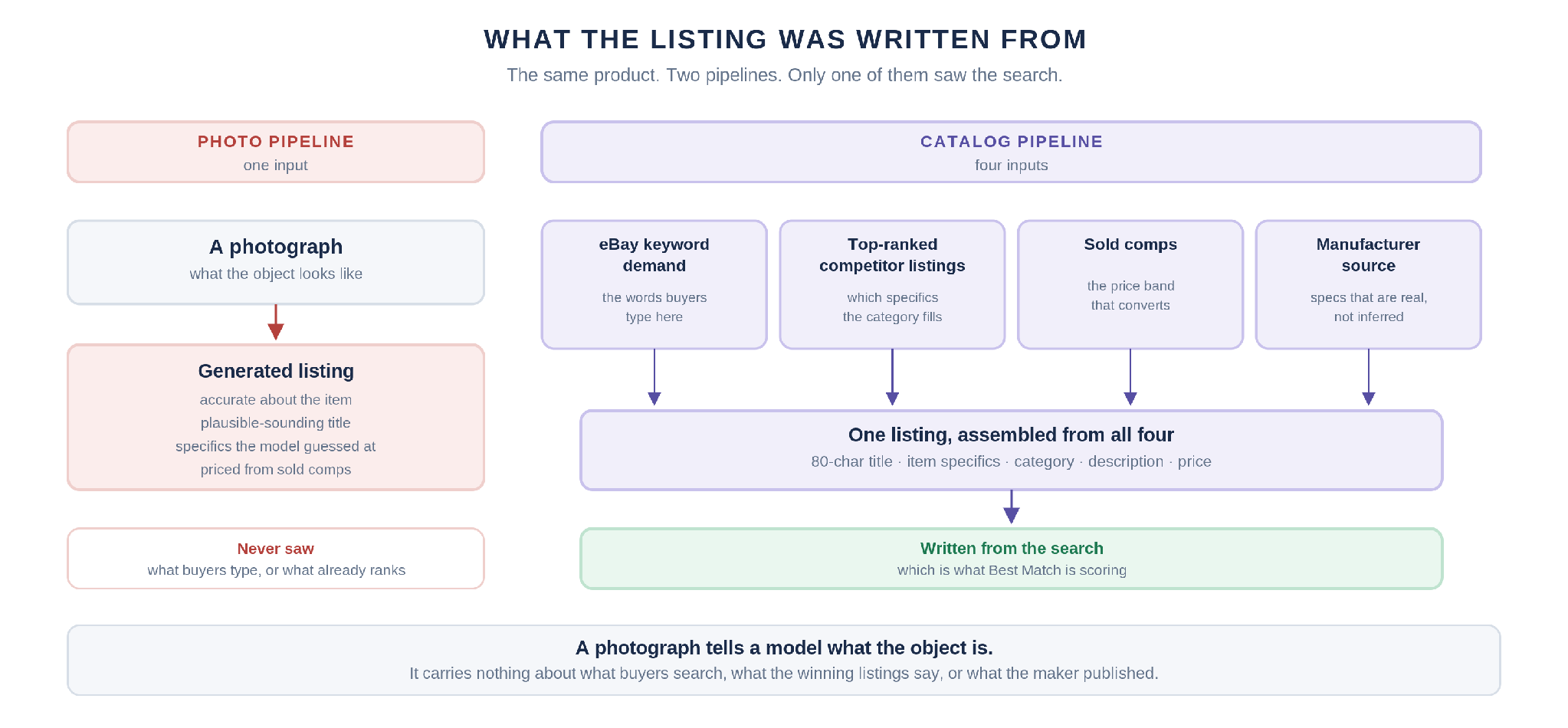
What the listing was written from. A photo pipeline has one input. A catalog pipeline has four, and only one of the two ever sees the search.
What an AI eBay Lister Actually Is: Three Categories
The tools sold under this name are not variations of one product. They are three different answers to three different problems, and the reason so many sellers conclude that AI listing tools do not work is that they bought the answer to somebody else's.
eBay's Native Listing AI
eBay builds this in and does not charge for it. The current generation, which eBay calls magical listing, was described on the company's Q4 2025 earnings call as a fully AI native architecture where AI agents create the title, category and item specifics from a photograph. It is good at what it does and it costs nothing.
Two constraints decide whether it is for you. It runs in the mobile app rather than on desktop, and it is aimed at private and personal sellers, with the rollout to business accounts still pending. A brand or distributor running a business account cannot simply adopt it, which is worth knowing before you plan around it. Independent testing through 2026 has also found the current version still misidentifies items and leaves the description empty by default.
Photo-to-Listing Reseller Tools
This is the busiest part of the market: FlowLister, Snap2List, Reseller Suite, ListFast, RGLister and others. You photograph an item, the tool identifies it, writes a listing and prices it against recent sold comps. They are built for one-of-a-kind inventory, which is exactly what thrift, estate and consignment sellers have, and for that inventory they are the correct tool. Most are eBay-first by design and explicitly not crosslisters.
Catalog-Scale Listers
The third category starts from a product record rather than a photograph. The input is a vendor feed, an ERP export, a PDF line sheet or a manufacturer page, and the output is listings for repeatable SKUs, often variant families, often on more than one marketplace. Pumice sits here. Nothing about this category is faster at photographing a single item, and it is not trying to be. It solves a different problem: getting a catalog onto eBay accurately, at volume, with the listings written to be found.
At a glance
Three categories of AI eBay lister, and what each one is built to list
Factor
eBay's native listing AI
Photo-to-listing reseller tools
Catalog-scale listers
What it reads to write a listing
A photograph taken in the app
Photographs, plus recent sold comps for price
A product record: vendor feed, ERP export, PDF line sheet or manufacturer page
Inventory it suits
A few personal items at a time
One-of-a-kind items: thrift, estate, consignment
Repeatable SKUs and variant families that reorder
Who it is open to
Private and personal sellers, mobile app only; business-account rollout still pending
Any seller, usually a monthly subscription per user
Brands, distributors and multi-channel sellers on business accounts
Cost
Free, built into eBay
Subscription, priced per seller
Priced against catalog size and enrichment volume
Sees what buyers search
No
No, though sold comps carry a price signal
Yes: keyword demand and ranking competitor listings are inputs
Works across other marketplaces
No, eBay only
Mostly eBay-first, and most say plainly they are not crosslisters
The three are not competing versions of one product. What you list decides which one is correct for you, and volume matters less than whether your inventory repeats.
Why Most AI eBay Listings Don't Rank
eBay ranks search results with an algorithm it calls Best Match, long known internally as Cassini. eBay does not publish a weighted factor list, but the inputs it consistently tells sellers to attend to are stable and not mysterious.
What Best Match scores
The listing inputs eBay consistently tells sellers to attend to
Input
What it measures
Title relevance
How well the title matches the words buyers actually type, with early words weighted
Item specifics
Completeness against the category's fields, because buyers filter on them and a missing field removes the listing from that filtered view entirely
Category
Whether the listing sits in the category buyers browse for that product
Price competitiveness
Where the price falls against comparable listings that are selling
Sell-through history
Whether this listing and this seller convert impressions into sales
A model that saw only a photograph can influence the wording of the first two and guess at the third. It has no access to what buyers type or to what the ranking listings already carry.
Read that list against a photo-generated listing and the gap is structural rather than a quality problem. The model saw the object. It did not see the search data. It has no way to know that buyers in this category search "cordless impact driver 20v" rather than "impact drill," and no way to know that the top five listings all populate a Voltage item specific that this listing leaves blank. The vendor guide at MyListerHub, written by one of its co-founders, states the position plainly: "AI itself does not boost ranking. eBay does not reward or penalize a listing simply because it was generated by AI." That is correct, and it is a striking thing for a company selling an AI listing tool to write down.
It is also only half the story. AI does not boost ranking. AI that writes from keyword demand, competitor listings and verified source data changes the things Best Match scores, which is a different claim and a testable one.
Most of this market sits between those two claims. One eBay AI suite promises to "automatically optimize your listings, boost your search rankings" and to "optimize for eBay's search algorithm with AI-powered keyword placement," with no mechanism, no data source and no numbers anywhere on the page. Another tool's homepage advertises 90,000 listings created in one band and runs a live counter reading 374,109 a few hundred pixels below it. Neither is a reason to distrust the category. Both are a reason to ask any vendor what the listing is written from before believing what it will do.
What "Based on Real Data" Means: The Four Sources
A listing built to rank is assembled from four inputs. A photo pipeline has one of them, and gets a fifth-hand version of a second through sold comps.
1. eBay Keyword Demand
What buyers in this category actually type, and how often. That determines which terms belong in the title and in what order, because eBay's title field is capped at 80 characters and spaces count. Eighty characters is not enough room for both the words buyers search and the words a model thinks sound complete, so something has to decide. Keyword demand decides.
2. The Competitor Listings Already Winning
The listings currently ranking in the category are a specification, not inspiration. They show which item specifics the category actually populates, how the winning titles are structured, and which attributes buyers are filtering on. A listing missing a specific that the top ten all carry is invisible to every buyer who uses that filter, regardless of how well written it is.
3. Sold Comps
Active listings are asking prices. Sold listings are evidence. The photo tools got this right and deserve credit for it, because price competitiveness is one of the inputs Best Match weighs and a listing priced outside the band that converts will underperform on every other axis too.
4. The Manufacturer Source
The vendor URL, the PDF line sheet, the supplier feed. This is the input that keeps the specifics true. Ask a general-purpose model to write a listing from a photograph and it will fill gaps with whatever is statistically plausible for that product category, which is how listings end up claiming a capacity, a material or a compatibility the product does not have. On a marketplace, an invented item specific is not a typo. It is a return, a defect on your account, and a signal to Best Match that this listing disappoints buyers.
Let’s talk about how people use Pumice to create ebay listings that actually sell.
What is Pumice?
Pumice is a SKU onboarding automation platform focused on creating product listings from sparse product data. Give it whatever you already hold, a title and an MPN, a supplier feed, an ERP export or a PDF line sheet, and it finds the live manufacturer or vendor source, pulls the real specifications off it, and writes the title, item specifics, category and description for each marketplace you sell on. It is built for brands and distributors with repeatable SKUs, not for one-of-a-kind resale inventory.
Method 1: The Pumice Merchandising Pipeline for eBay
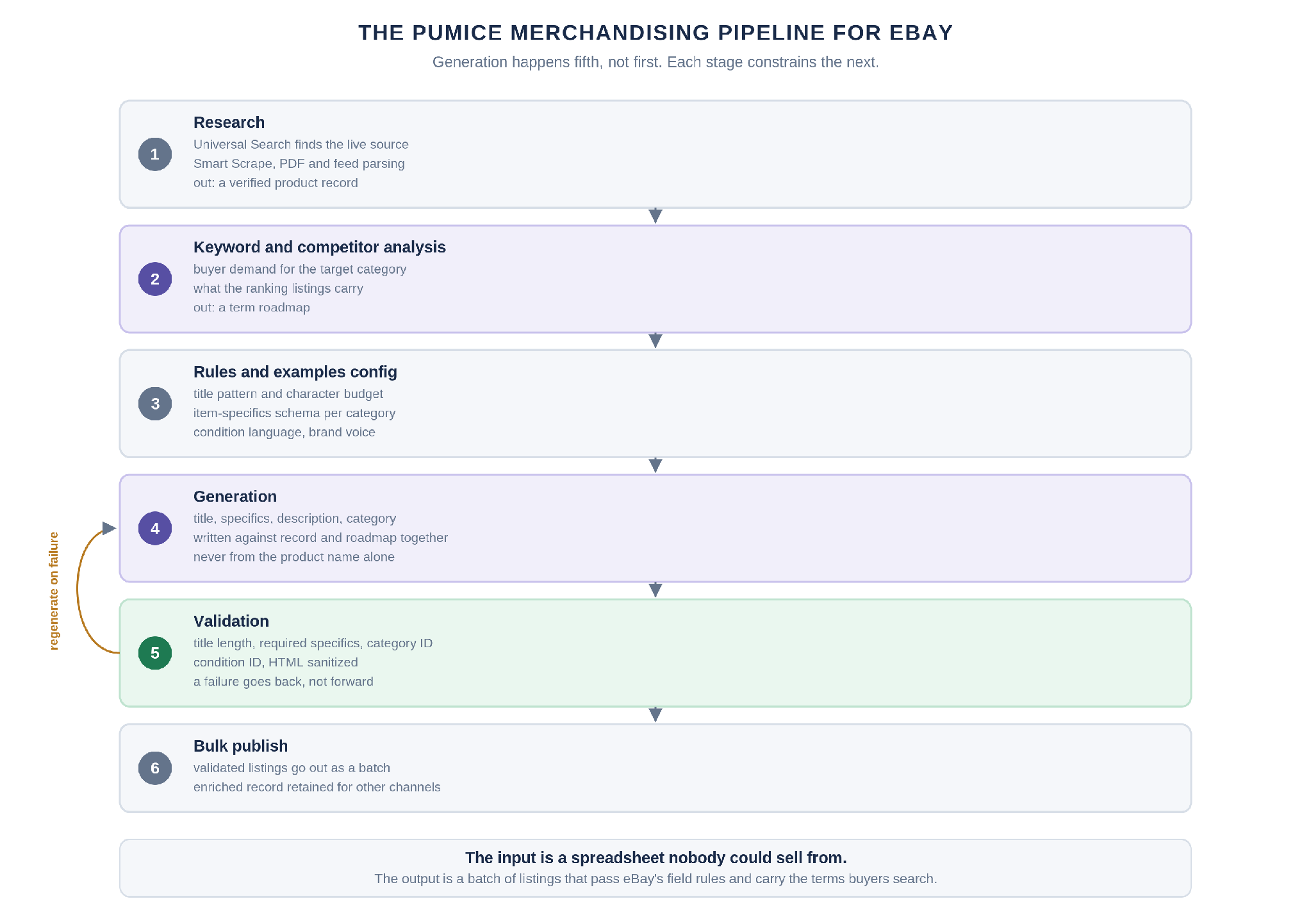
The pipeline runs in six stages. The order matters, because each stage constrains the next, and generation happens last rather than first.
Research. Pumice takes what a merchandising system already holds, usually a title, an MPN and a brand, and finds the live source for that product. Universal Search locates the best vendor or manufacturer page, Smart Scrape pulls the structured content off it, and PDF line sheets and supplier feeds are parsed into the same shape. The output is a verified product record rather than a guess.
Keyword and competitor analysis. For the target eBay category, the pipeline pulls buyer demand data and the currently ranking listings, and builds a term roadmap: which keywords have to appear in the 80-character title, which belong in item specifics, and which item specifics the category populates that this product is missing.
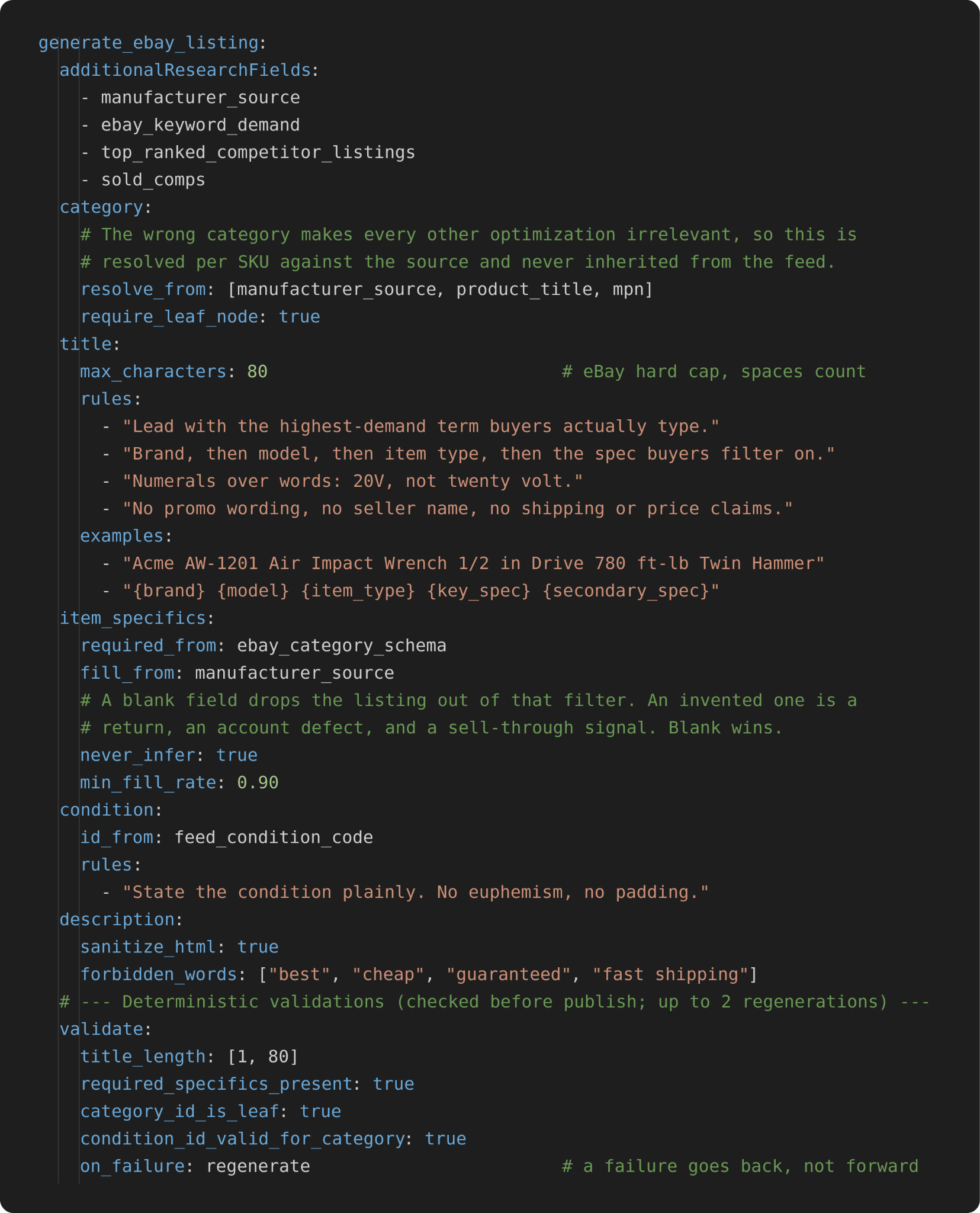
Rules and examples configuration. This is where the eBay-specific constraints live. Title pattern and character budget, the item-specifics schema for the category, condition language, brand voice, prohibited claims. Configuration is per-category rather than global, because a title pattern that works for power tools is wrong for apparel.
Pumice merchandising pipeline configuration for an eBay category, showing the title pattern, character budget and item-specifics schema.
Generation. Title, item specifics, description and category are generated against the verified record and the term roadmap together. Nothing is written from the product name alone.
Validation. Output is checked against eBay's field requirements before anything is queued: title length, required item specifics for the assigned category, valid category ID, condition ID, HTML sanitized for the description field. A record that fails goes back for regeneration rather than forward to publish.
Bulk publish. Validated listings go out as a batch, with the enriched record retained so the same product can be reformatted for other channels without being researched again.
A worked example. A distributor takes on a 500-SKU vendor line and has an ERP export with part numbers, brand and a one-line description per item. That export cannot be listed: no item specifics, no category assignment, titles that are internal part descriptions rather than anything a buyer would search. The pipeline researches each part number against the manufacturer's own catalog, assigns the eBay category, builds titles from the category's actual keyword demand, fills the item specifics the category requires, and validates the batch before a single listing goes live. The distributor's input was a spreadsheet nobody could sell from.
The six stages in order. Generation happens fifth, not first, and a validation failure goes back to generation rather than forward to publish.
Method 2: Keeping Listings Ranking, and Checking Whether They Do
Listings are not finished when they publish. The competitive set changes, categories add item specifics, and the terms buyers use drift with the season and with the product cycle. A listing that ranked in March can be mid-page by August without anything about it changing.
The Product Optimization Playbook runs the same analysis as the initial build, against live listings rather than new ones. For each SKU it compares the live listing to the listings currently ranking in that category and reports the gaps: item specifics the category now populates that yours leaves blank, title keyword drift where the terms buyers use have moved, price band drift where the converting range has shifted away from your price. The output is a prioritized list of specific changes per SKU, not a score.
Measuring whether any of it worked happens in eBay's own Seller Hub, which reports impressions, click-through rate and sell-through rate per listing. Take a fixed set of SKUs, record those three numbers before the changes, make the changes, and compare after a full sales cycle for that category. Impressions tell you whether the listing is being surfaced, click-through tells you whether the title and price are competitive once surfaced, and sell-through is the one that pays. Listing count is not a metric. A thousand listings nobody sees is a worse outcome than two hundred that convert.
One Product Record, Every Marketplace
Most catalog sellers are not only on eBay, and the marketplaces do not agree on anything. eBay wants an 80-character title and a deep item-specifics schema that varies by category. Amazon wants a longer title, five bullet points and backend search terms that shoppers never see. Walmart wants its own attribute schema again. The product is identical in all three.
Photo-to-listing tools cannot bridge this, and the good ones say so directly rather than pretending otherwise. Their pipeline starts with a photograph of a specific item and ends with an eBay listing, so there is no reusable record in the middle to reformat.
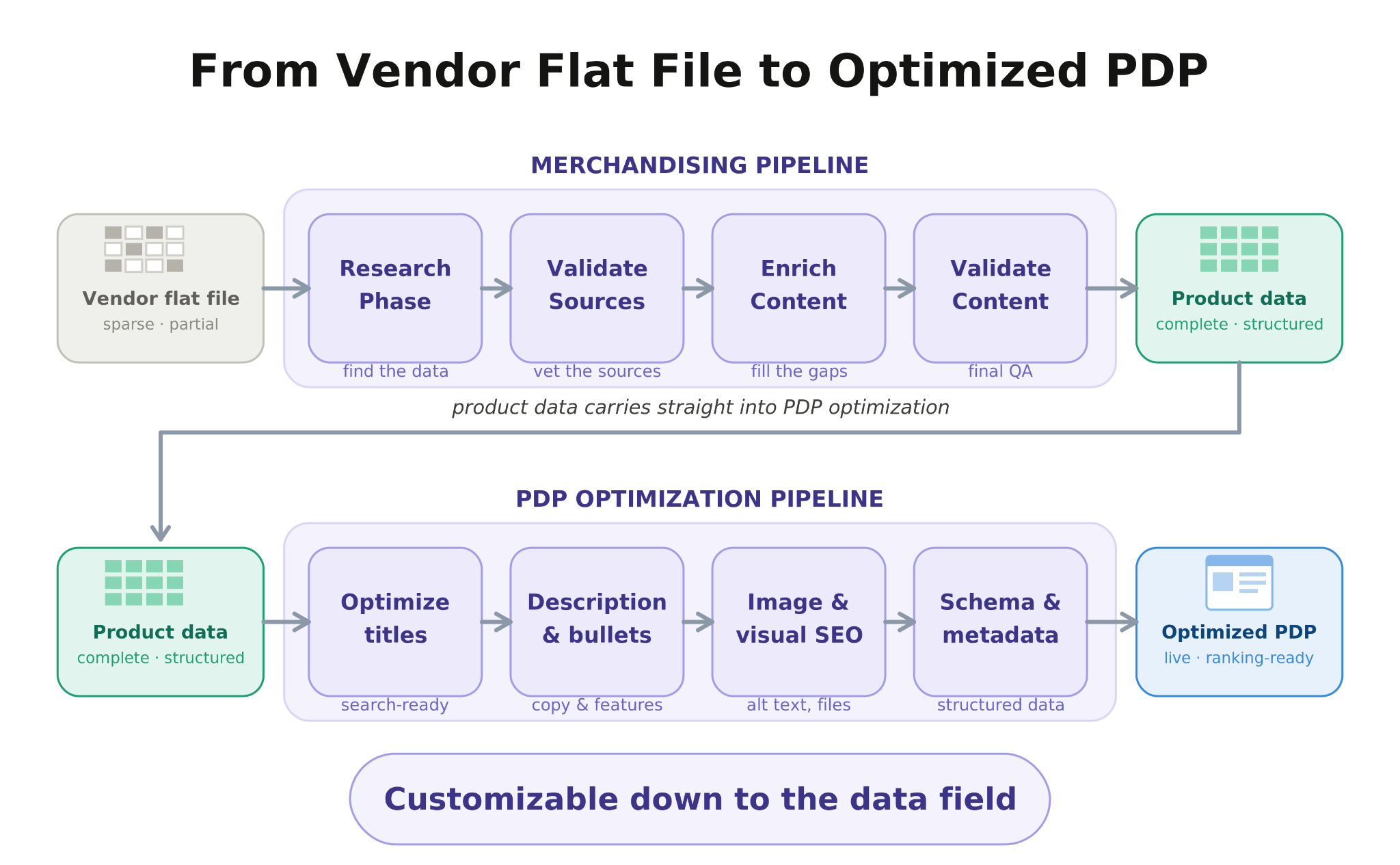
A catalog pipeline inverts that. The research and enrichment happen once and produce a product record, and each marketplace is a formatting configuration applied to that record. Adding Amazon to an existing eBay catalog is a configuration, not a second research project. This is also what makes the source-to-marketplace queries tractable, whether the source is an Amazon catalog, a WooCommerce store or a supplier feed, because in every case the work is getting to a verified record first and formatting second.
Which AI eBay Lister Should You Use?
Most people reading this should not use Pumice, and saying so is more useful than pretending the categories are interchangeable. What you list decides the tool, and volume matters less than whether your inventory repeats.
Pick by what you list
Which AI eBay lister fits your inventory
If you are
Use
Because
Selling a few personal items a month
eBay's native listing AI
Free, built in, and enough for the volume. Mobile app, personal accounts
A thrift, estate or consignment reseller with one-of-a-kind inventory
A photo-to-listing tool such as FlowLister or Reseller Suite
Your items are unique, so a photograph really is the only usable input. Sold-comp pricing is the right pricing model
Doing retail arbitrage from barcodes
A barcode-first lister
The UPC already identifies the product, so the research problem is mostly solved
A brand, distributor or multi-channel seller with repeatable SKUs
A catalog-scale lister such as Pumice
Your input is vendor data rather than photographs, the same product repeats, and the listings need to work on more than one marketplace
Most sellers reading this should not use Pumice. If your inventory is one-of-a-kind, the reseller tools are better at your job than we are.
If your inventory really is one-of-a-kind, the reseller tools are better at your job than we are, and the most useful comparison of them is FlowLister's ranked roundup, written by a full-time eBay seller who discloses that he built the tool he ranks first. That disclosure is worth more than most vendor neutrality.
98% accuracy following term based title generations. This means that when your rules contain a specific format of product information items, it follows these. For example if your rule is a specific order “{brand} {product name} {color} {keywords} {sku} it follows that format.
99% accuracy on correct schema for ebay descriptions. Correct html tags, format (bullets, paragraphs, sentence count).
Conclusion
Every AI eBay lister on the market will produce a listing that sounds right. The ones built on photographs will do it in thirty seconds, and for unique inventory that is the correct trade. What none of them can do, because the input does not contain it, is write a listing from what buyers search, what the winning listings in the category already say, and what the manufacturer actually published. Those are the inputs eBay's Best Match responds to, and a listing written without them is a well-written listing nobody sees.
Listing a Vendor Catalog on eBay?
Tell us what your product data looks like now, an ERP export, a supplier feed, a folder of PDF line sheets, and how many SKUs need to go live. We will tell you what is listable from it today and what has to be researched first.
Free to try
See what your eBay listings are missing
Run a set of your live eBay SKUs through the Product Optimization Playbook. It compares each listing against the listings currently ranking in that category and reports the gaps.
Item specifics the top listings carry and yours leaves blank
Title keyword drift against what buyers in the category search
Price band drift against the comps that are converting
Yes, and eBay builds it in at no cost. Photograph an item in the mobile app and its listing AI drafts the fields for you. The limits are account type and device rather than capability: business accounts are still waiting on the rollout, and there is no desktop equivalent. Third-party tools exist to cover what that leaves out, which is unique resale inventory at one end and vendor-catalog volume at the other.
Does AI improve eBay search ranking?
Not on its own. Best Match is indifferent to how the text was produced, so a tool promising a ranking boost purely from using AI is describing something that does not exist. Ranking responds to listing content: whether the title carries the terms buyers search, whether the item specifics the category filters on are filled, whether the category and price are right, and whether the listing converts. Generation can move all of those, but only if the research that feeds it happened first. A photograph does not contain any of it.
What is the difference between a photo-to-listing tool and a catalog lister?
The input. A photo-to-listing tool identifies a specific physical item from images and prices it against sold comps, which is the right approach for inventory that never repeats. A catalog lister starts from a product record built out of vendor data, keyword demand and competitor listings, which is the right approach when the same SKU is listed repeatedly, in variants, or across several marketplaces. Neither is a better version of the other.
Can one tool list the same products on eBay, Amazon and Walmart?
A catalog-scale tool can. Once a SKU has been researched and enriched once, publishing it to a second marketplace is a matter of reformatting to that marketplace's field rules rather than starting over. Photo-based tools generally cannot, since nothing durable survives between the photograph and the finished eBay listing, and most say outright that they are not crosslisters.
Will an AI-written listing get my eBay account flagged?
Not for being AI-written. eBay is neutral on how listing content is produced and has shipped its own generative listing tools. What does cause problems is inaccuracy: an item specific that does not match the product, a condition description that overstates, a claim the manufacturer never made. Those generate returns, defects and policy issues whether a person or a model wrote them, which is the practical argument for grounding generation in verified source data rather than a prompt.



.png)