Ecommerce Product Data Normalization: A Field-by-Field Guide
How to normalize ecommerce product data field by field: identifiers, attributes, units, categories and PDP copy, against one schema, with rules and AI
Matt Payne
November 9, 2026
Your rank tracker shows it plainly: a competitor's product page passed yours for your best keyword last month. It shows the date, the positions and the traffic you lost. It does not show why.
Brand-level competitor analysis stops short of that answer.
Comparing brands, prices, marketing channels and social media presence is useful once a year. Rankings and conversions, though, are decided page by page: which attributes a page states, which questions it answers, how its title is built and what proof sits near the buy button.
Ecommerce competitor analysis earns its keep at that page level: comparing the pages that outrank yours, element by element, and turning what most of them share into changes.
A full analysis covers both levels. It maps your competitors' assortment, pricing, shipping, marketing and site experience, then compares the pages that outrank yours, so you know where you stand and why a page lost.
Competitor analysis in ecommerce means studying the stores and product pages that compete for your customers and searches, to find what they do better. The goal is practical: higher rankings, a higher conversion rate and a clearer competitive advantage.
Shopify's guide describes a competitive analysis as "a structured process for identifying direct and indirect competitors" and comparing their products, pricing, marketing and sales. We split competitors into three types:
Ecommerce adds a fourth group to the competitive landscape: search competitors. These are the pages that outrank you for the keywords you want, and they are often marketplaces, retailers and publishers rather than the industry leaders you think of as rivals.
Competitor analysis works at two levels. The brand level compares each ecommerce brand on assortment, pricing, shipping, positioning and marketing, and it sets business strategy. The page level compares the product and category pages that win specific searches, and it changes rankings and conversion rates.
Use the brand level when you plan: entering a category, spotting market gaps, setting prices, choosing shipping and returns policies or deciding how to position the store. Do it once or twice a year, after market shifts, or when a new competitor appears.
Use the page level when you want to maximize sales of specific products: a page that slipped in rankings, a product with traffic but few sales, or a launch that needs to rank. Do it whenever a page matters and its rankings or sales move.
A brand-level review looks at the business behind each competing online store. Run it across your direct and indirect competitors and the marketplaces and other sales channels that rank for your products, and record each finding in the same columns so the stores line up side by side.
Marketing analysis takes the longest to evaluate. I recommend signing up for each competitor's emails and follow their main social accounts for a few weeks, because how often they send and what they offer tells you as much as the marketing messages themselves. To follow competitors' marketing across many stores, a social media monitoring tool saves time, and ad libraries show their advertising strategies.
Then sum it up in a SWOT. List your strengths and weaknesses against the stores you reviewed, then the opportunities and threats their choices and marketing tactics create, such as a category they ignore or a free-shipping threshold lower than yours. The SWOT closes the brand-level review; the page-level comparison in the steps below explains individual rankings.
Search engines rank pages, not brands. For a product query, the top results usually share patterns: the attributes they state, the questions they answer, how their titles are built and whether they carry Product markup. Finding those patterns tells you what a page needs to compete for that query.
Markup is part of it. Google's product structured data documentation describes how Product markup can make a page eligible for product snippets and merchant listing experiences in Search. A competitor with markup and you without it are not competing on equal terms.
AEO and GEO raise the stakes. Structured data helps AI systems as well as Google parse a product page. In answer engine optimization, the goal is to get your page cited inside answers from tools like ChatGPT and Google's AI Overviews. Complete specs in Product schema give those tools exact facts to quote.
The pages that win searches often win the sale too, because they answer the buyer's doubts. Trusted Shops points to reviews, guarantees, checkout, delivery information and clear return policies, and says "Trust is often the strongest lever."
Here is a hypothetical example. Say four of the top five pages for "waterproof hiking boots women" state the waterproof membrane and a fit note near the top, and three show reviews with photos. Your page has none of these. That one comparison explains both the ranking gap and part of the conversion gap.
This method runs from the brand level down to the product page. Steps two to six are where rankings and conversions change.
You cannot compare every page by hand, so start where a win pays most. Pick three kinds of target: high-revenue products, pages that get impressions but few clicks, and products in competitive categories with strong consumer demand.
Pages with impressions and few clicks are often a good place to start. Google already shows them for the query, so the problem is usually the title, the product meta description or what the page offers once a shopper lands. A page-level comparison tells you which.
List the keywords each important product or category should win. Use the terms your target audience searches, such as "women's waterproof hiking boots" or "cordless drill 20V," not your brand name. Add terms for emerging trends as they appear.
Search each keyword and note the five to ten pages that rank above you on the search engine results pages. Include any pages cited in AI answers or shown in Google Shopping. These are your search competitors for that product, and they may not be the brands you expected. Our PDP Optimization Playbook system automates the gap analysis process for SEO ranking and AEO visibility.
Compare assortment, competitor pricing, shipping thresholds, returns and positioning across the competing brands behind those pages. Shopify's frameworks, such as a SWOT analysis, help organize what you find. Elogic's checklist I like also suggests comparing "what's emphasized on category/PDP pages," which leads straight into the next step.
Keep this pass short and practical. Note each brand's price range for the product against your own prices, its free-shipping threshold, its returns window and its delivery promise. Note how it describes itself in one line. Those four or five facts often give more valuable insights than a long strategy document.
Open each winning page next to yours and go through the checklist in the next section, element by element, to uncover gaps. Note what each page does, not what you think it should do.
A single competitor's quirk is not a pattern. Count how many of the winning pages share each finding. If four of five list a spec you leave out, that is a strong signal; if one of five does, it is a weak one.
Write each gap as a specific change for one page: what to add or change, the evidence, and how many winning pages do it. Prioritize the changes most winners share and the pages that matter most to revenue.
Competitors rebuild their pages, market demands change and rankings shift. Re-run the comparison after you make changes, to confirm the gaps closed, and whenever a ranking moves.
Done by hand, steps two to six can take hours per product. That is fine for five flagship products and unrealistic for a catalog of five thousand.
The same method works for category and collection pages, which often rank for broader terms. Compare the category pages on competitor websites that outrank yours on their intro copy, the filters they offer, how many products they show, the subcategory links and any buying guidance near the top.
Category pages often lose for different reasons than product pages. Common gaps include thin intro text, missing filters for the attributes buyers care about and no links to the subcategories shoppers expect.
Measure each changed page against itself and against pages you did not touch. Track its ranking for the target keyword, its click-through rate in Search Console and its conversion rate. Give changes a few weeks before you judge them, because rankings take time to settle.
If a page improves and an untouched page in the same category does not, the change probably worked. If both move together, something else, such as seasonality or a change in consumer behavior, is likely behind it.
Use this checklist in step four. Each row is something to compare between the winning pages and yours, and why it matters for search, conversion or AI answers.
Download the free product page competitor checklist (Google Sheets)
Salsify's own steps ask the same kind of question: "Do they have detailed product descriptions and rich multimedia content, or are they basic bullet points?" Each gap sits in one part of the product detail page: images, title, price, reviews, specs, or shipping and returns. Fix it there, one element at a time.
Take the same hypothetical hiking boot. You search "waterproof hiking boots women" and open the five product pages above yours. You go down the checklist and mark each one.
Four of the five name the waterproof membrane in the title or first line. Five of five list the weight per boot. Four have a fit note, such as "runs half a size small." Three show reviews with photos, and all five carry Product markup with a rating.
Your page has a weight, but no membrane in the title, no fit note, no photo reviews and no markup. Your change list writes itself: add the membrane to the title, add a fit note near the size selector, add Product and review markup, and ask recent buyers for photo reviews.
Pay attention to buyer questions. Google's guidance on high-quality reviews asks writers to explain what sets a product apart from its competitors and to share measurements. Strong product pages can answer the same things.
SEO suites are essential for competitor analysis, and we use tools like Ahrefs in our own competitor research. The question is what each is built to show.
Ahrefs' Rank Tracker lets you compare your site against up to 10 competitors for rankings and organic traffic, and its Content Gap tool finds the organic keywords competitors rank for that you don't. Semrush's Keyword Gap compares keyword profiles side by side for up to five competitors.
Both now compare content too. Ahrefs' AI Content Helper grades a page's topic coverage against the pages that rank above it, and Semrush's SEO Writing Assistant uses top-ranking rivals to recommend related keywords, length and a readability target. Similarweb lets you compare traffic sources and channels across search, display and social media. I’ve played with the Ahrefs tool and its decent.
Those tools are built for SEO analysis of keywords, traffic and topic coverage. They are not built to open the product pages that outrank yours and list the product data on them that is missing from yours: the specs, the fit notes, the size information, the review volume, the trust copy and the Product markup.
They also do not count how many of the winning pages share each finding, or turn the result into a change list for one SKU. Rank tracking tells you that you lost; a page-level analysis tells you why.
So keep your tracker. It finds the pages worth analyzing and tells you when a ranking moves. The page-level brief is the next step after it.
Your SEO suite does most of the competitor SEO work in steps one, two and seven. Use its keyword research and its gap reports on competitor keywords to choose the keywords each product should win. Use its rank tracking to see which pages outrank yours and to watch for movement after you change a page.
Steps four to six are where it hands off. Once you know which pages beat yours, the comparison of what is on those pages happens in a browser, in a spreadsheet like the checklist above, or in an automated brief. Using both together gives your SEO strategy the who and the why.
A page-level comparison for every product is the work most teams never get to, which makes it a competitive edge. Pumice runs it with AI agents, one product at a time, for as many products as you have.
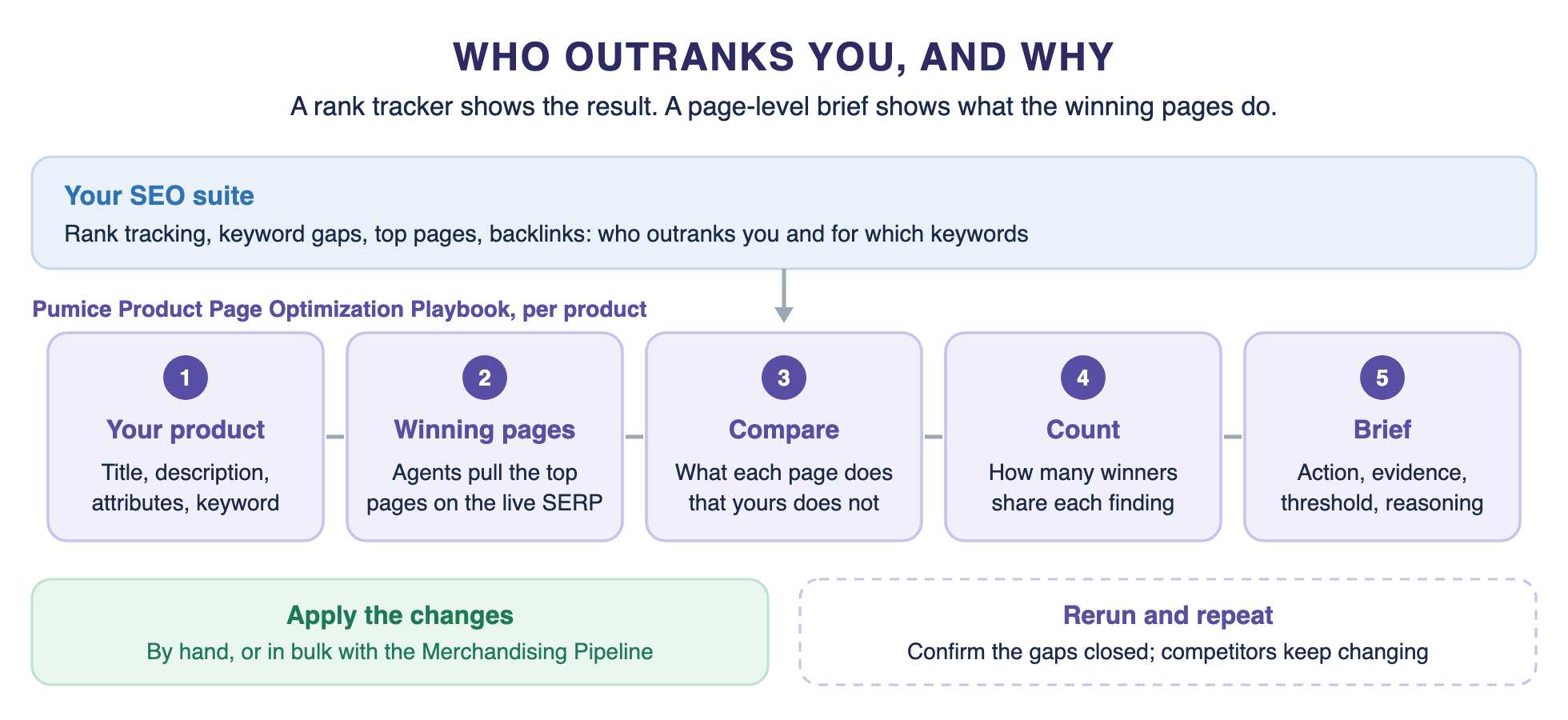
The Product Page Optimization Playbook takes a product's existing title, description and attributes plus the target keyword. The Pumice Agentic System then analyzes the page against the top-ranking competitor pages on Google right now, so the brief works from up-to-date data.
The output is a structured PDF. It sets your current product data beside the competitor data from the first page of results, runs a gap analysis between them and shows a keyword distribution analysis of which ranking terms appear in the top competitors' titles. Then it lists action items.
Every action item carries four pieces of information: the action to take, the evidence behind it, a threshold check showing how many competitors do it, and the reasoning. Here is what one looks like.
That is the page-level comparison from the seven steps, done for one product: what the winning pages do, how many of them do it and why it matters, for one product. Pumice describes it as an agency-style audit in minutes instead of weeks.
The Playbook does not invent product facts or rewrite the page. It tells you what to change; you or your team decide. Facts still come from your product data and the manufacturer.
A brief is useful to more than the SEO team. Merchandisers fix the attributes and specs it flags. Content writers on the marketing team rework titles and descriptions. Customer experience teams add fit notes, size guidance and answers to common questions from customer feedback.
Because every action item carries its evidence and a count, each team can see why a change matters before they make it. That can shorten the debate that often stalls competitor findings.
For one page, apply the changes by hand. For many, the Merchandising Pipeline runs them as one catalog optimization batch. It fills missing attributes from each product's source and rewrites titles and descriptions. Then it validates every record before syncing it back to your store or PIM.
Then run it again. Pumice can run the same analysis on a schedule, because competitors keep changing their pages. On large ecommerce sites, sort each round by revenue-weighted impressions so a small team fixes the pages that matter most first.
Most competitor analysis that fails to change results fails for one of these reasons.
Each of these is easier to avoid when the comparison follows the same checklist every time and counts patterns rather than impressions. A shared checklist also makes results comparable from one quarter to the next, so you can see which gaps you closed and which new ones opened.
No single competitor intelligence tool does every job. Here is what to use for each part of the work.
Ecommerce competitor analysis works best in two layers. Use your SEO suite to follow competitors' search strategies: who outranks you and for which keywords. Then compare the winning product pages with yours, count the patterns they share, and turn the gaps into changes for each page.
Doing that by hand works for a handful of products. For a catalog, Pumice's AI agents write the brief for every product, with the evidence behind each change, so your team spends its time making changes instead of finding them.
Pick a product and the keyword you want it to win. Pumice's AI agents compare it with the pages that outrank it and return a brief of exactly what they do that yours does not, with the evidence behind each change.
• Your current product data against the first page of results
• A gap analysis and keyword distribution across the winning pages
• Action items with evidence, a threshold count and reasoning
• No invented product facts: it tells you what to change, you decide
Use Ahrefs or Semrush for rankings and keyword gaps, Similarweb for competitors' traffic sources, ad libraries for advertising campaigns and BuiltWith for tech stack analysis. For what winning product pages do that yours do not, use a page-level brief such as Pumice's Playbook.
Product, price, place and promotion, the marketing mix that the U.S. Chamber of Commerce suggests as a starting point. On a product page they map to specs and content, price display, shipping and availability, and the claims and proof near the buy button that shape perceived value.
The five steps are: identify your competitors, gather market research on their products, pricing and marketing, compare them with your own business, sum up the findings in a SWOT, and turn them into actions. In ecommerce, add a page-level step for the products that matter most: compare the pages that outrank yours and count the patterns they share.
List the stores and pages that compete for your customers and keywords, including marketplaces. Compare their assortment, pricing strategy, shipping, marketing and site experience, and sum it up in a SWOT. Then, for your most important products, compare the pages that outrank yours element by element and turn what most of them share into changes.
Run a brand-level review once or twice a year to catch market trends, and a page-level comparison whenever a key ranking moves or after you change a page. At catalog scale, run it on a schedule to stay ahead of changes.
Yes, at the page level. AI agents can pull the pages that outrank yours, compare them with your product page and count the patterns, while a person decides which changes to make.
Yes. Both terms describe studying competitors to improve your own position, and they are generally used interchangeably.
Yes. Download the product page competitor checklist above: list the five pages that outrank yours, mark which elements each one has, and the count column shows where the gaps are.