SEO for external seller marketplaces is two jobs with one name. The first is ranking the platform backend, the category pages, location pages, and listing pages that a marketplace owns and controls. The second is the quality of the product data sitting inside those pages, which arrives from hundreds or thousands of independent sellers who each describe, title, and categorize their inventory differently. Do the first job well and the second badly, and you have a beautifully structured site full of listings that cannot rank.
Worth clearing up, because it derails more marketplace SEO conversations: this is not Amazon/eBay/Walmart SEO. (I already wrote a guide on that)
Optimizing your listings on somebody else's marketplace is a different focus. That work is about winning a slot inside Amazon's or eBay's internal ranking system. Marketplace SEO is about ranking your own marketplace in Google.
This covers both sides of the platform problem, with the multi-seller catalog treated as an SEO surface rather than a content chore, and the Pumice pipeline that enforces listing quality across it.
SEO for marketplaces is the practice of optimizing an online marketplace so that its category pages, location pages, and seller listings rank in search engine results. It differs from ecommerce SEO in two ways: marketplaces rank heavily for location-based and near-me queries, and the product data comes from independent sellers rather than from one merchandising team, which makes catalog consistency a ranking factor. An effective marketplace SEO strategy covers keyword research, category page architecture, listing indexation strategy, seller data quality, and structured data.
Key Focus Areas
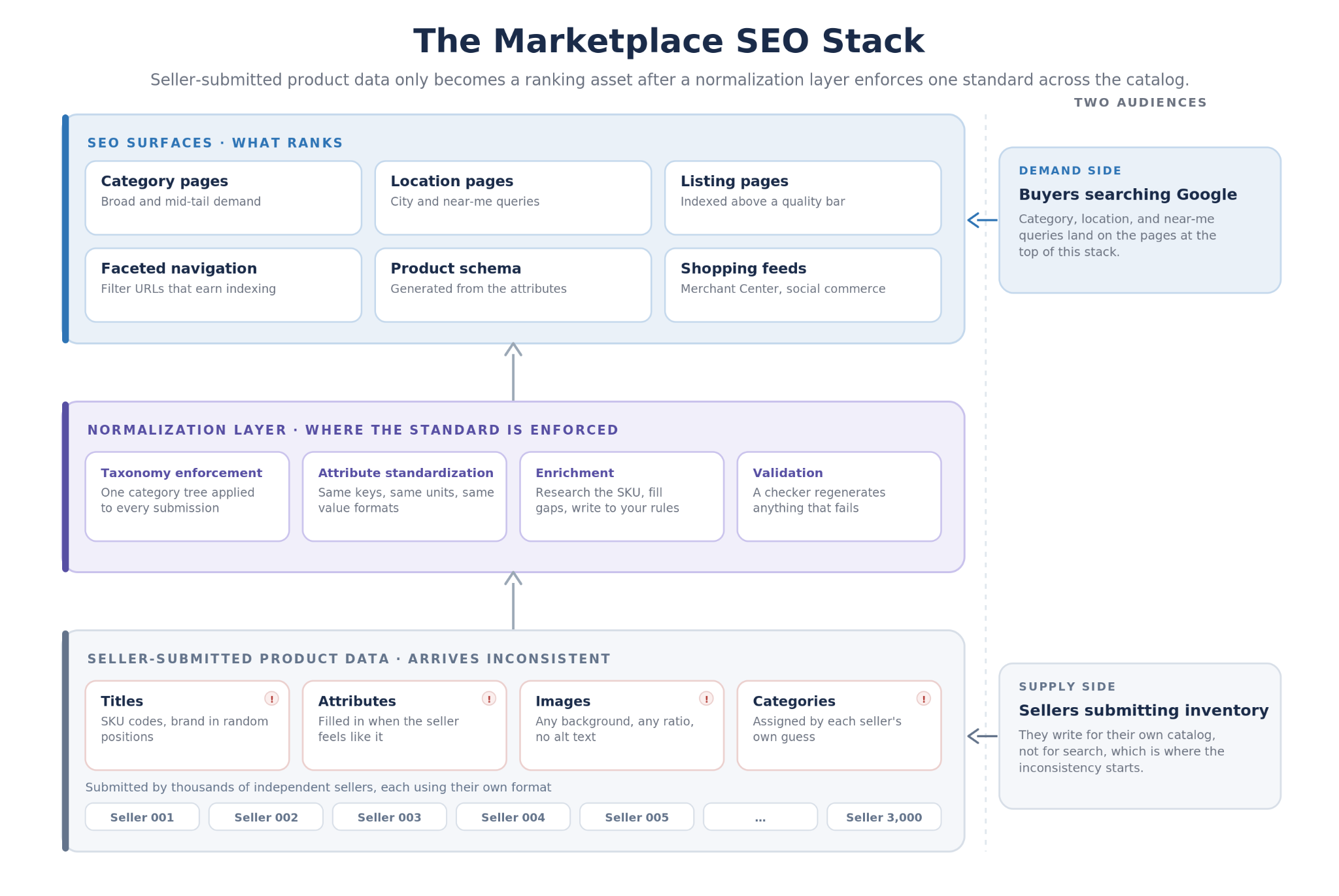
Marketplace search engine optimization is a platform problem and a catalog problem at the same time. Ranking pages you control means nothing if the seller data inside them is thin or wrong.
Category pages are where marketplaces rank for broad and mid-tail queries, which makes product categorization an SEO function rather than an operations chore.
Location and deeply refined queries are the biggest structural advantage a marketplace has over a standard ecommerce store, and most marketplaces underbuild for them.
PDP listing pages need an indexation policy, not a blanket rule. Index the ones that earn it, “noindex” the rest, and set the threshold deliberately.
AI answer engines surface marketplaces now, and the same gap-closed listings that win Google organic also win AI Overviews, ChatGPT shopping, and Perplexity.
Enforcing listing quality across thousands of sellers is a data pipeline problem. Pumice runs that pipeline: enrich sparse seller data, generate SEO-ready product titles and descriptions, and validate against your category rules.
Marketplace SEO stack. Your goal is to drive organic traffic with no thin category pages, complete PDPs, and strong supplemented content creation.
Why SEO for Marketplaces Is Different
Marketplaces share a lot of surface area with ecommerce sites. Both have category pages, product pages, reviews, and a checkout funnel. The differences that matter for search are structural, and there are three main ones.
You Do Not Control The Provided Product Data
A retailer with one merchandising team can enforce PDP structure like title format, a description length, and an attribute schema by building an SOP and training four people. A marketplace with three thousand sellers cannot. Every seller submits titles in their own style, fills in the attributes they feel like filling in, writes descriptions of wildly varying quality, and assigns categories based on their own taxonomy.
That is not a content problem, it is a data pipeline problem, and it is the single biggest determinant of whether a marketplace's listing pages can be consistent and rank. Advice to have good listings is easy to give and hard to act on. The useful question is what system enforces quality across a catalog you did not write.
AI Search Surfaces Marketplaces Now
Google AI Overviews, ChatGPT shopping, Perplexity, and Gemini all surface marketplace listings, and they pull from the same PDP data that SEO rewards: complete attribute tables, specific descriptions, structured data, and answered questions. A listing with three attributes filled in and a two-line description does not get cited, because there is nothing to cite. The effort done for product pages to improve AEO is the same as SEO.
Keyword Research For Marketplaces
Marketplace keyword research splits into three buckets, and the mistake most platforms make is spending all their effort on the first one.
Category, Location, and Informational Intent
Category queries are the broad and mid-tail terms your category pages should own, from wide terms down to specific ones like womens waterproof hiking boots. Location queries are where marketplaces have a structural advantage that pure ecommerce sites do not, covering city terms, neighborhood terms, and near-me variations. Informational queries are the questions buyers and sellers ask before they transact, and they feed the content strategy covered later.
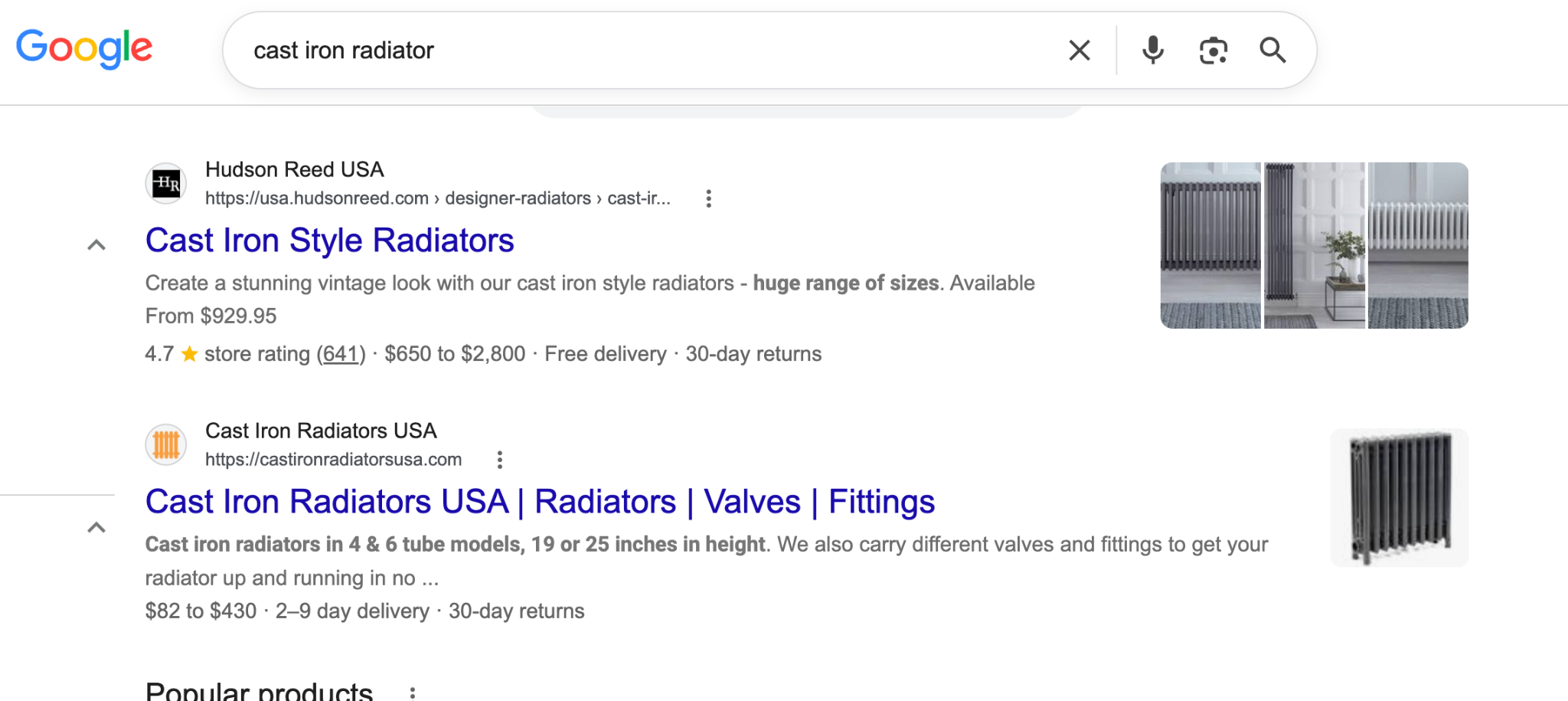
Location intent deserves more weight than it usually gets. Near-me queries have grown across essentially every marketplace category, and the approach that works is combining the near-me variation with the city page rather than building them separately. SpotHero ranks in top positions for both nyc parking and parking garage near me off the same location pages, which is the pattern to copy.
Let Keyword Research Pick the Page Type
The temptation is to make listing pages carry the keyword strategy, since a marketplace has thousands of them and only dozens of category pages. That inverts the leverage. A single listing serves one item in one place, so it can rank for a hyper-specific query and nothing else. A category page filtered by location and attribute serves the whole demand pattern underneath a query. Build the keyword map at the category and location level first, then let listings capture the long tail keywords where it makes sense (specific versions, attributes, etc)
On-Page Optimization for Marketplace Listing and Category Pages
On-page SEO optimization is where we clean up seller provided data for the many levels of quality that can be provided to marketplaces. This is the highest leverage area of focus for most marketplaces.
Product Titles and Descriptions That Sellers Did Not Write Well
Seller-submitted titles are optimized for the seller’s catalog management, not for search. They contain internal SKU codes, inconsistent brand placement, missing attributes, and occasionally the word NEW in capitals four times. A marketplace that publishes those verbatim inherits every problem in them. The more challenging piece for external seller marketplaces is that not only do they need to clean this up for SEO, but for catalog standardization as well. Having different product data for the same SKU can lead to duplicate listings.
The fix is product data field standardization the platform enforces, not a guideline it publishes. A workable title format names the brand, the product, the differentiating attribute, and the category term, in a fixed order, within your character limit. Descriptions need enough specific detail to answer what the buyer would otherwise have to ask, which is also what makes them liftable by AI answer engines.
Attributes Are the Part Everyone Under-Fills
Attributes drive faceted navigation, filter accuracy, product schema completeness, and shopping feed approval. They are also the field sellers skip most often, because filling in fourteen attribute values per listing is tedious and the seller does not feel the cost of leaving them blank. Your marketplace does. A listing missing material, size, and color cannot appear in the filtered category pages that would have surfaced it, so the inventory exists and is functionally invisible.
Structured Data for Product Listings
Product, Offer, AggregateRating, Review, and Breadcrumb schema are the baseline for marketplace listings, with Organization and FAQ on supporting pages. Schema is generated from your product data, which means schema completeness is capped by attribute completeness. This is the loop that runs through this entire playbook: fix the data and several SEO surfaces improve at once.
Site Structure, Categories, and Faceted Navigation
Category pages for broad keywords rank well IF they make sense for that keyword
Category Pages Are the Ranking Surface, and Facets Are the Trap
That ranking surface makes category architecture the highest-stakes structural decision on the site. Each one needs a keyword-aligned H1, unique intro copy that is not templated across four hundred pages, and enough inventory underneath it to justify existing. Location-crossed categories, meaning a category filtered to a city, are where marketplaces beat ecommerce sites outright.
Faceted navigation is the same mechanism turned against you. Every filter combination generates a URL, and a marketplace with eight facets can produce more crawlable URLs than it has products. Decide deliberately which facet combinations get indexed, typically the ones with real search demand and enough inventory to look populated, and canonicalize or noindex the rest before Google decides for you.
Categorization Is an SEO Function
Here is the connection nobody makes explicitly: if category pages are the ranking surface, then whatever assigns products to categories is an SEO system, and on a marketplace that system is thousands of sellers guessing at your taxonomy.
The scale makes it unforgiving. On marketplace categorization work we have run at Width, the taxonomy involved 5,585 categories and roughly 50 million records a month. At that volume a 5% miscategorization rate puts 2.5 million products on the wrong SEO surface every month. Each one breaks four things at once: it is missing from the category page that should rank for it, it corrupts the facet counts on the page it landed in, it generates schema describing the wrong product type, and it maps incorrectly into Google Merchant Center.
None of that shows up in a rankings report as a categorization problem. It shows up as category pages that underperform for no visible reason. Enforcing one taxonomy across seller-submitted data is the fix, and it has to be automated, because no human team reviews 50 million records.
Marketplaces that do this well are rarely the household names. The strongest SEO performers tend to be niche platforms that dominate one vertical:
Content Marketing That Builds Marketplace Authority
Informational content does two jobs on a marketplace. It captures demand upstream of the transaction, and it gives Google evidence that the platform knows its category rather than just hosting inventory in it.
Segment it by topic in the URL structure rather than dumping everything into one blog folder. TrustedHousesitters.com splits blog content into separate sub-folders by theme, which builds topical authority per segment and makes performance analysis possible by grouping related content under one path. On a marketplace this matters more than on a standard site, because the informational topics span both audiences and blend into one undifferentiated feed otherwise.
The seller-side content is the half most marketplaces skip. Sellers search for how to price, how to list, what fees apply, and whether the demand is real. Those queries are low competition, they attract supply rather than demand, and supply acquisition is usually the more expensive side of a marketplace to grow.
Visual Content and Image SEO at Marketplace Scale
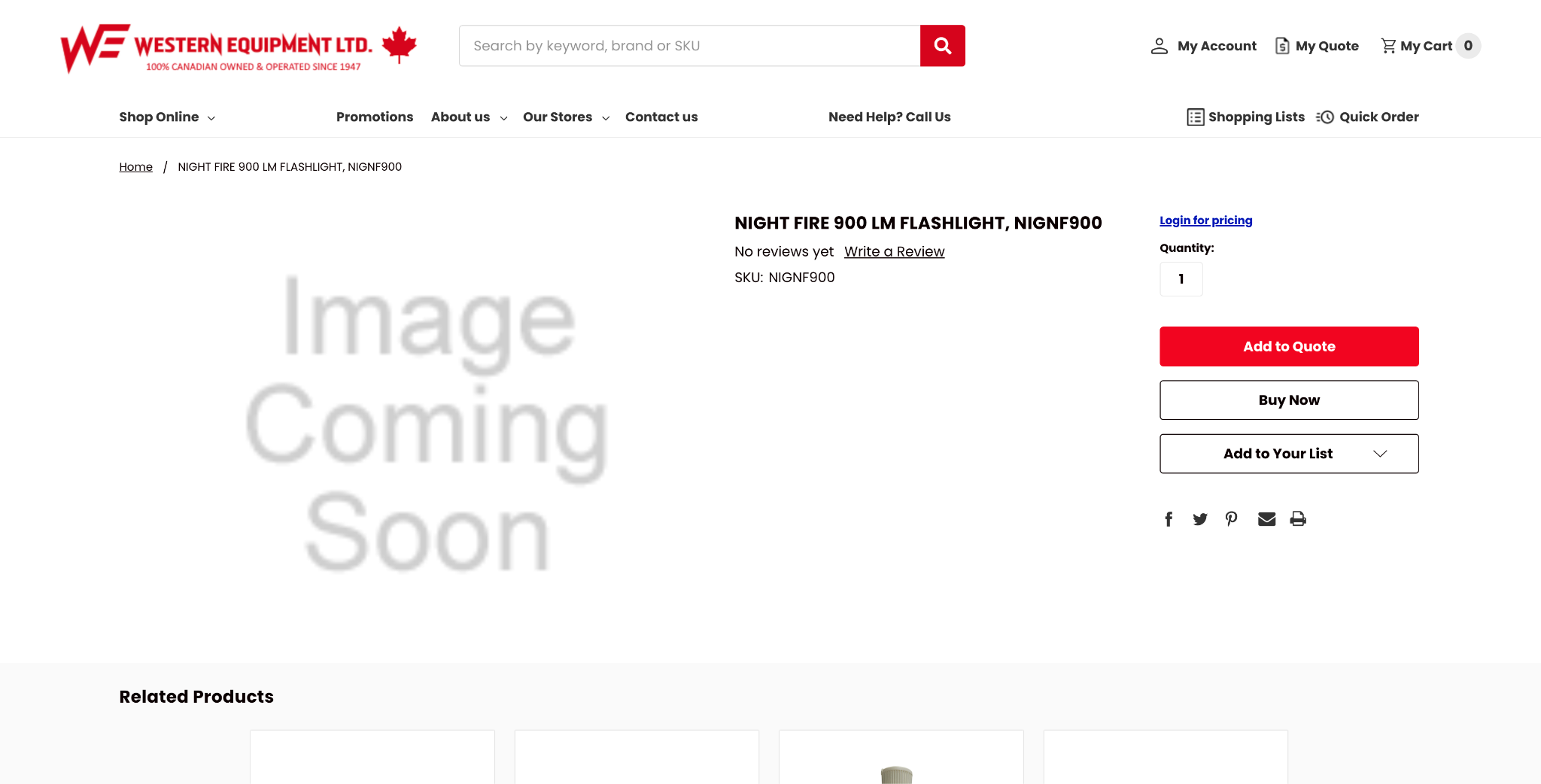
Images for listings on marketplace platforms comes from each seller, which means it arrives inconsistent (if at all). Different backgrounds, different aspect ratios, different quality, and frequently no alt text at all. Image quality drives conversion directly, and image metadata drives visibility in Google Images and visual search.
Dont end up with product pages like this. This will not lead to organic search results.
Three things are worth enforcing at the platform level. Set image standards sellers must clear, covering minimum resolution, primary image background, and a required number of angles. Generate alt text from product data rather than asking sellers for it, since alt text written from a structured record is more accurate than alt text written by a busy seller. And add image structured data so listings are eligible for the image-rich results that product searches increasingly return.
Automate Marketplace Listing SEO and AEO With Pumice
All the optimization work above is a serious lift for any team, especially as a marketplace where you are constantly onboarding new products and new vendors. Pumice is a sku onboarding automation platform focused on automating the work going from vendor provided SKUs to fully enriched product records that actually rank. Our ai agents research, retrieve, and write product listings that follow your exact marketplace copy guidelines and rules.
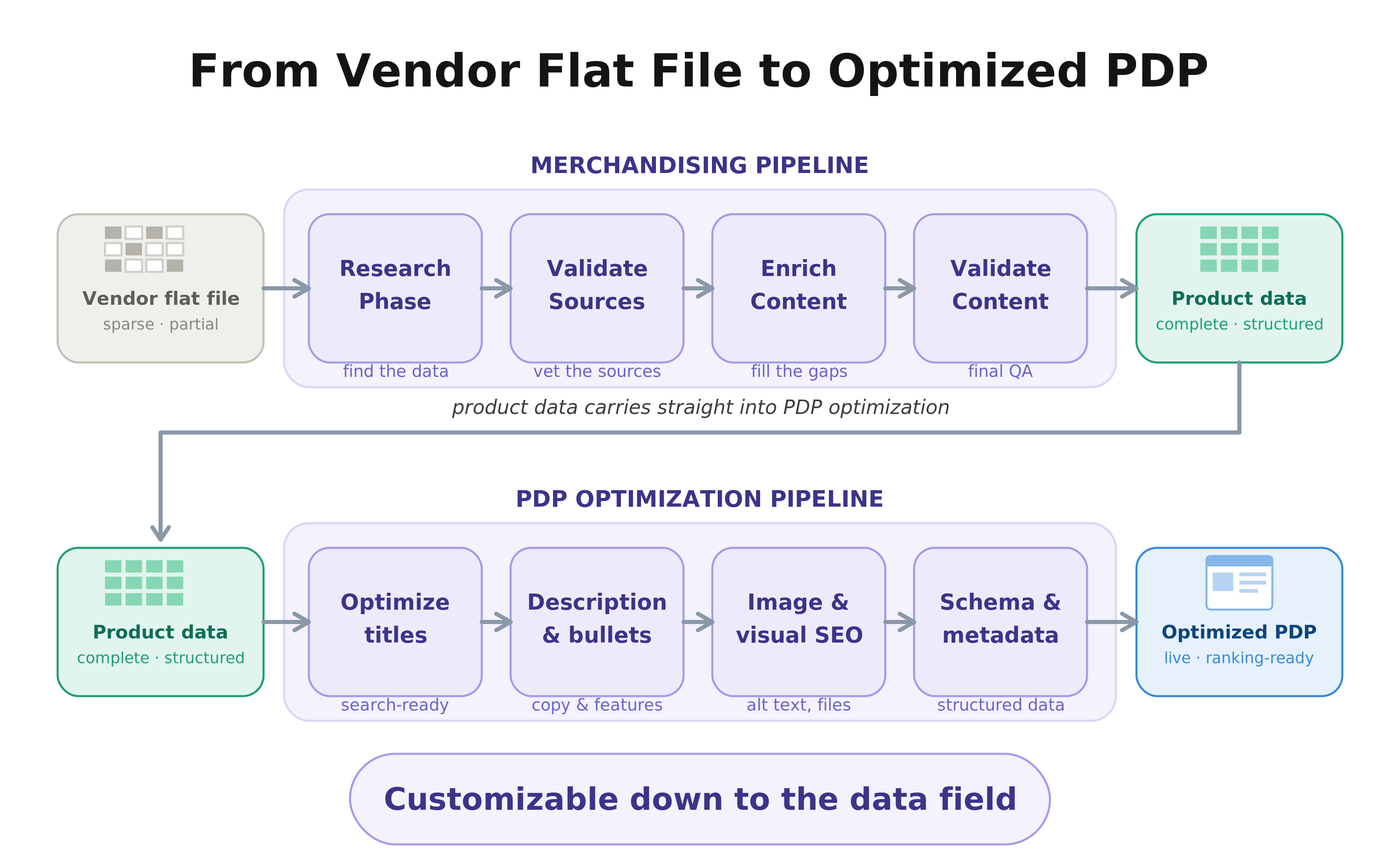
We have two different starting places depending on the initial quality of your product data.
Method 1: Merchandising Pipeline When Seller Data Is Sparse
Start here when your product data is too sparse to perform SEO optimization. The pipeline researches each product against manufacturer and retailer sources, validates that the data it found belongs to that exact product, then generates enriched titles, descriptions, attribute sets, and bullet points against your rules. It runs catalog-wide, thousands of listings per job, rather than one product at a time.
Method 2: PDP Playbook for Optimization of Product Pages
Start here when your product records already have complete data and you want to optimize it for SEO/AEO. The Product Optimization Playbook analyzes the pages ranking for your target query, compares them against your listing, and returns a specific set of changes to the title, description, attributes, and on-page structure. This is the per-SKU pass for flagship listings and high-value categories, run after enrichment rather than instead of it.
[Merchandising Pipeline] Step 1: Research Phase for Seller Data Augmentation
The merchandising pipeline starts at the research phase focused entirely on augmenting the amount of data we have for a specific SKU. We can’t enrich SKUs without actual data, or we end up with hallucinated junk that leads to returns, poor ranking, and incomplete PDPs. Using the existing SKU data like the name and unique product identifier Pumice searches the web to find manufacturer product data from sources you define, keeping you in control of where the data comes from. This can be manufacturer sites, competitors, or the original vendor pages. The ai scraper extracts the required product data from these sites (title, description, attributes, images etc). A validation agent then checks the extracted data against the original listing to confirm it is the same underlying SKU. This is a huge part of the equation, as it keeps ai agents from creating copy for a SKU from a different SKU that is very similar. ChatGPT and other non-grounded tools mess this part up, which leads to wrong attributes.
💡 From production
Oftentimes the vendor provided flat files are an ERP export, but the actual vendor site contains an enriched version written by the content team. You can set this up to extract the enriched version from the real vendor site on ingestion.
You can also provide the research step any PDF catalogs you’ve received from the vendor to use as grounded data. We find this very helpful in production as this data is generally sourced directly from the manufacturer. Our ai agents dig through the PDF to find the product data for the specific SKU. Use it as a replacement for the web search, or additional context alongside web search.
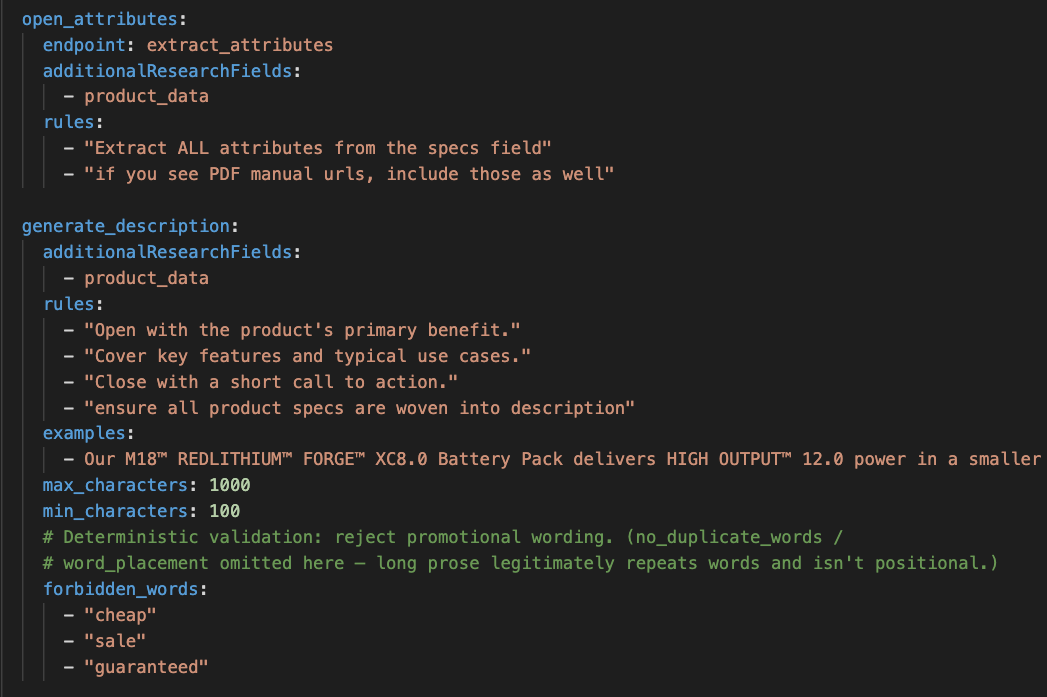
The Pumice Merchandising Pipeline configuration view, showing a marketplace CSV mapped to the pipeline fields with the research phase enabled and a manufacturer domain specified.
[Merchandising Pipeline] Step 2: Generate Product Pages that follow your exact rules, guidelines, and schema
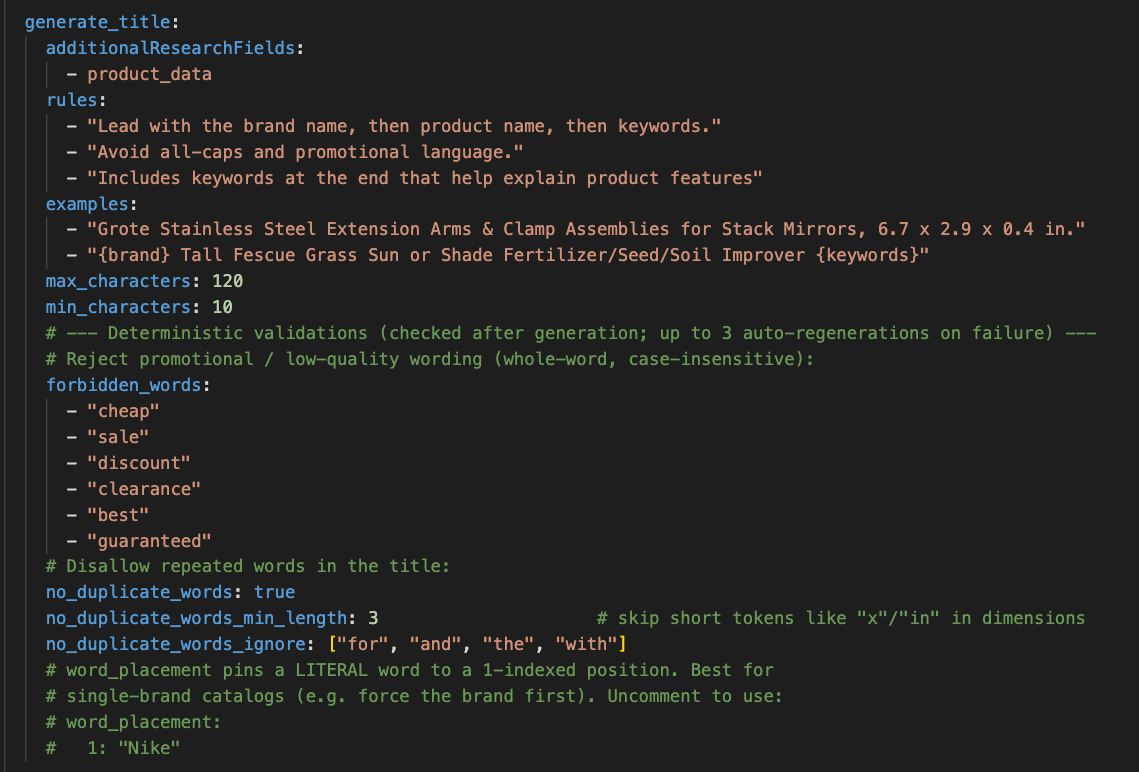
With the SKU research complete, our generation agents write new copy following provided rules, examples, and validations. Each field (title, bullet, description etc) can hold their own set of these allowing for per field refinement.
Rules. Natural-language instructions the agents follow during product data generation. Title format, information to include, required attribute keys, banned terms, category-specific requirements. For a marketplace these encode your listing policy, so the standard is enforced by the pipeline instead of by seller documentation nobody reads.
Examples. Examples of listings you consider correct. Rules like “use relevant keywords” are vague on their own, and examples teach the agents what good looks like in your categories specifically.
Validation. A checker agent reads the generated listing against your rules and regenerates anything that fails. This is what allows the pipeline to run unattended across thousands of listings.
The Pumice rules configuration showing marketplace listing rules: title format, character limits, required attributes, and banned terms.
[PDP Playbook] Step 3: Optimize Product Listings for SEO/Search Visibility
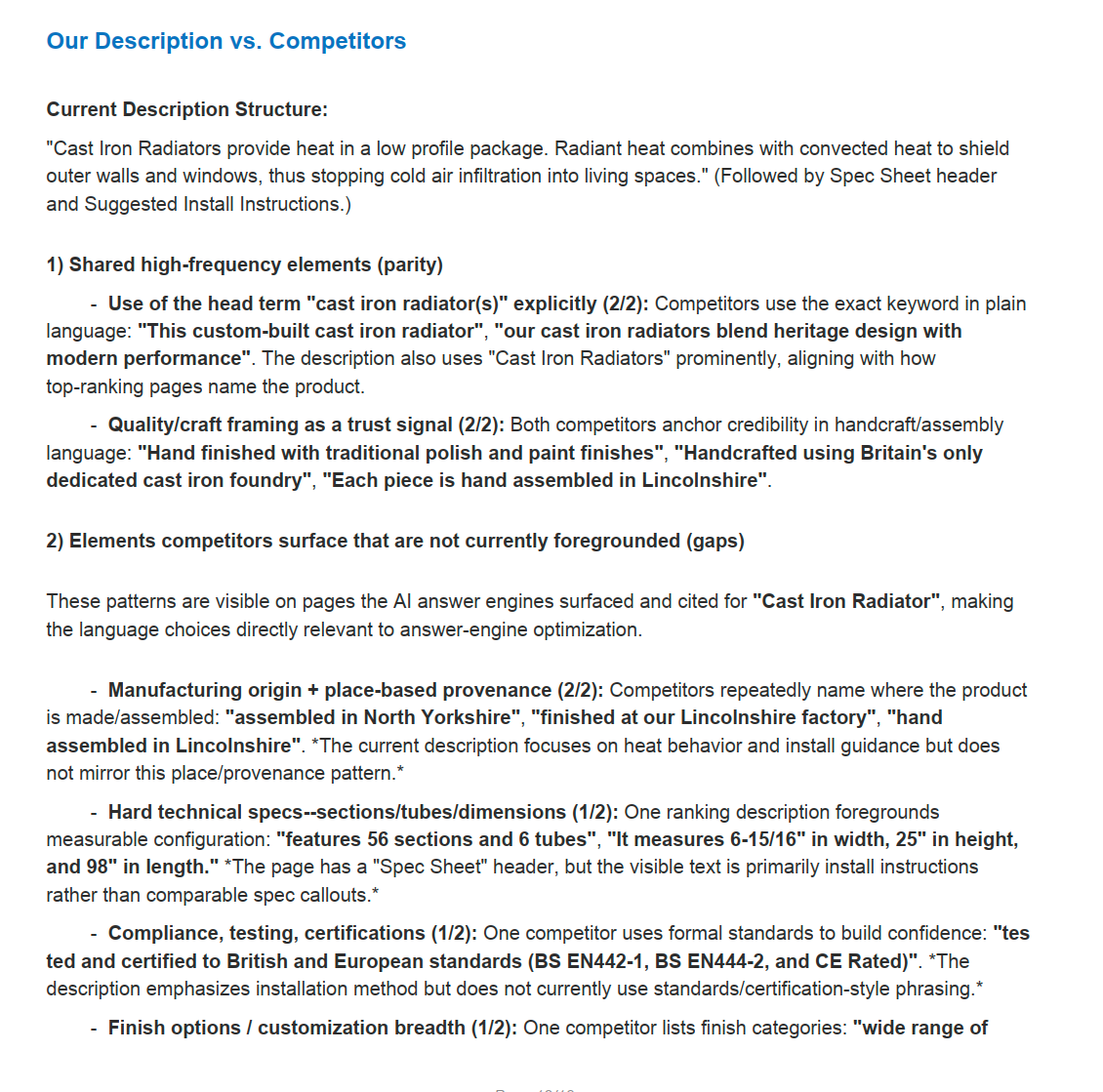
With the product data page enriched, the Playbook does the focused pass on listings that carry disproportionate revenue. It scrapes the competing keyword pages, runs the gap analysis, and returns a shareable report with the specific changes to make. Run it on flagship listings and on category pages that should rank higher than they do.
A page of the Pumice Playbook report showing the gap analysis between a marketplace listing and the pages currently ranking for its target query.
Why the Same Pipeline Serves AEO
The same PDP optimizations that make a listing rank in SEO are the outputs ai search results use to decide ranking. A complete attribute table answers specification questions directly. A description with real detail gives an AI model something to quote. Question and answer blocks generated from product data map onto exactly the queries people type into ChatGPT and Perplexity. Marketplaces that close listing gaps for SEO get AEO visibility as a side effect, and marketplaces that leave listings thin are invisible on both surfaces for the same reason.
A few areas to track that usually make sense for results.
Revenue from organic. Anyone doing SEO should tell you this is the number one goal. Keyword growth, first page results, search rankings etc don’t matter if its not driving revenue.
Category page rankings and organic traffic, which is where broad and mid-tail demand lands.
Near-me and location query performance, tracked separately via google search console because it behaves differently from category demand.
Attribute completeness and categorization accuracy across the catalog, because these lead the ranking metrics rather than following them.
Merchant Center approved item rate, which is the clearest single measure of feed-layer health.
Give it 90 days before drawing conclusions on structural changes.
Conclusion: Build a Marketplace SEO Engine That Compounds
Marketplace SEO rewards structure over volume. Category pages built around real demand, location pages that capture near-me intent, an indexation policy applied deliberately to listings, and structured data generated from complete product records. None of that is exotic, and most marketplaces have some of it already.
What separates the platforms that compound from the ones that plateau is the catalog underneath. Seller-submitted data does not improve on its own, and the volume makes manual review impossible past a certain size. Enforce the standard with a pipeline, and every surface downstream improves at once: category pages fill correctly, facets work, schema validates, feeds get approved, and answer engines have something to quote.
Start with the category architecture, fix the taxonomy enforcement underneath it, then run enrichment across the catalog and the Playbook across your priority listings.
Rewrite Your Marketplace Catalog for SEO and Conversion in Minutes
Pumice.ai runs the full marketplace merchandising pipeline described in this article: catalog ingest, seller-submitted product research, rules-driven title and description generation, and validation against your marketplace category rules. Free to try, no credit card required. Bring a CSV of listings where the descriptions still come from seller-submitted vendor feeds and see how Pumice rewrites them at scale.
How is marketplace SEO different from ecommerce SEO?
Ecommerce SEO is the closest discipline, and the two share category pages, product pages, reviews, and checkout. Marketplaces differ in that location-based and near-me queries carry far more weight, product data comes from many sellers rather than one merchandising team, and listing pages exist at a scale that forces an explicit indexation policy. Marketplaces also optimize for two audiences at once, buyers and sellers. You still have the same focus on site speed, link building, and canonical tags.
Should marketplace listing pages be indexed for better organic search?
Not by a single blanket rule. Most marketplaces start with listing pages set to noindex, because seller-written pages vary enormously and the page count runs into the millions, then allow indexation once a listing clears a quality threshold such as complete attributes, sufficient unique description text, or a minimum number of reviews. If you noindex listings, make sure robots.txt is not also blocking them, because Google must crawl the page to read the directive.
How does product categorization affect marketplace site SEO?
Directly, because categories are the surface that captures broad and mid-tail demand. A miscategorized product never appears where buyers would find it, throws off the filter counts wherever it did land, generates schema describing the wrong kind of product, and maps into shopping feeds under the wrong node. At marketplace scale, a small error rate across millions of records means a large volume of inventory sitting on the wrong SEO surface, which reads as underperforming category pages rather than as a data problem.
How do marketplaces show up in AI search and AI Overviews?
Answer engines quote from the same material organic search rewards: filled-in specifications, product descriptions with real detail, valid structured data, and questions already answered on the page. A listing with three attributes and two lines of copy gives them nothing to work with. Marketplaces that enforce listing completeness for SEO gain AI visibility from the same work, which is why catalog quality is now the shared input to both surfaces.
What does technical SEO and off page SEO look like for marketplace websites?
Technical seo work is mostly about controlling scale with the nature of multiple vendors: an indexation policy for listing pages, canonical and noindex rules for faceted URLs, sitemaps segmented by page type, server-side rendering for JavaScript-heavy front ends, and internal links that push authority from category pages down into the listings underneath them. Off-page work looks different from standard link building, because the strongest marketplace links come from proprietary data, meaning reports built from transaction or pricing information nobody else holds. Alongside that, user generated content on listings and category pages produces relevant content at a volume no editorial team could match, which is what lets a marketplace attract organic traffic across thousands of long-tail queries without writing every page by hand.




.png)