Organic search drives 53% of all website traffic (BrightEdge), which makes search the single biggest growth channel for a jewelry business online. SEO for jewelry stores, or search engine optimization for a jeweler, is the work of ranking for the specific searches buyers run before they choose a piece, from “diamond engagement rings” to “14k gold rope chain necklace.” Jewelry is a high-trust purchase: shoppers research for weeks, compare stones and metals, and buy online, in a showroom, or both. A strong jewelry SEO strategy, as part of your wider digital marketing, captures that demand wherever it lands and turns long research sessions into online sales, online visibility, and in-store appointments.
This guide covers the seo strategies that move the needle for jewelry websites in 2026: keyword research, on-page, site structure and schema optimization, content that builds trust, visual and image SEO, backlinks, and local SEO for stores with a physical presence. Then it shows how the Pumice Product Optimization Playbook automates the per-product work so your flagship engagement rings and slow-moving SKUs match how the top of the search results are actually written.
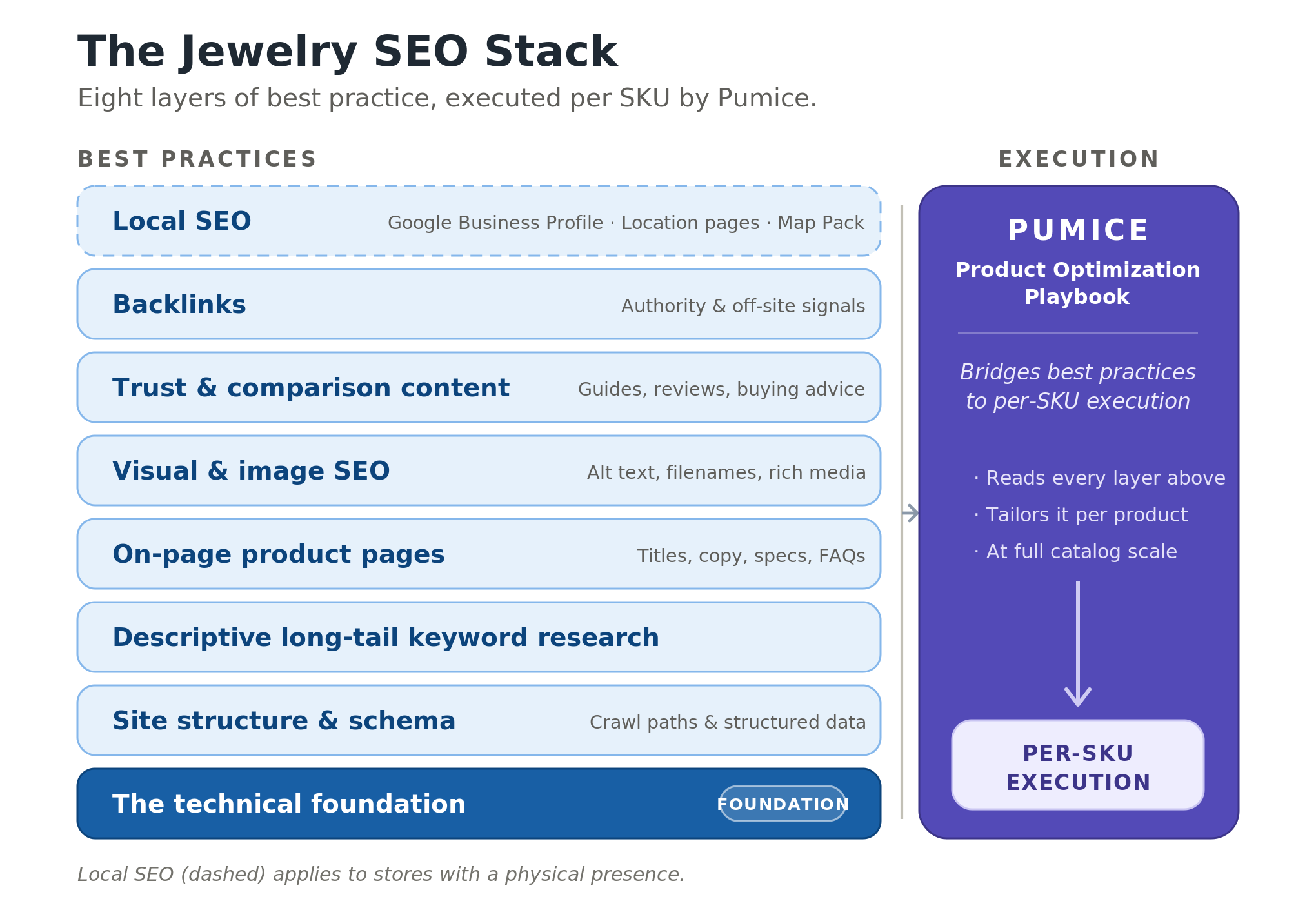
Jewelry SEO is not generic ecommerce SEO. The jewelry industry has different buying patterns, trust requirements, and a local dimension that changes how you prioritize the work. Three differences matter most.
Jewelry demand spikes around life events and retail peaks rather than spreading evenly across the year. Valentine’s Day drives “heart pendant” and “rose gold necklace” searches, Mother’s Day drives “birthstone jewelry,” summer brings “bridal set” and “tennis bracelet,” and December gifting brings “diamond stud earrings” and “pearl necklace.” Plan the SEO and content calendar around these peaks 6 to 8 weeks ahead, not month to month, so seasonal hubs are indexed and ranking before qualified traffic arrives.
Engagement rings and custom pieces carry unusually long research cycles. Shoppers compare stone type (natural versus lab-grown), shape and carat, metal (rose gold versus white gold), setting, provenance, ethical sourcing, and financing before they buy. That generates a deep long tail of comparison and educational queries that fashion jewelry never produces, and it is exactly where a smaller jeweler can outrank the giants.
Jewelry shoppers tend to discover and shortlist on mobile, then switch to desktop to compare and check out, so PDPs have to perform on both surfaces. Some late-funnel searches also carry local intent, like “jeweler near me” and “ring resizing near me.” For jewelers with a physical location, local intent complements organic product and content SEO rather than replacing it; for purely online brands, that same product and content work is where the revenue comes from.
Keyword research is the foundation of every page, because it connects what shoppers type into the search bar with the pages you publish. Jewelry buying is research-heavy and deeply descriptive, so the keyword universe is wide and full of winnable long-tail terms.
Target descriptive, relevant keywords instead of generic product type terms. “Snowy fox enameled necklace,” “dog mom jewelry,” and “vintage engagement rings” are winnable target keywords, while “jewelry” and “ring” put you straight against Tiffany, Kay, Zales, and Etsy where ranking is impractical. Use an SEO tool like Ahrefs or Google Keyword Planner to find phrases with real search volume and low keyword difficulty, and start with the lowest-difficulty terms to build momentum quickly. Mine Google’s related searches, People Also Ask, and current jewelry trends for the exact phrasing real buyers use.
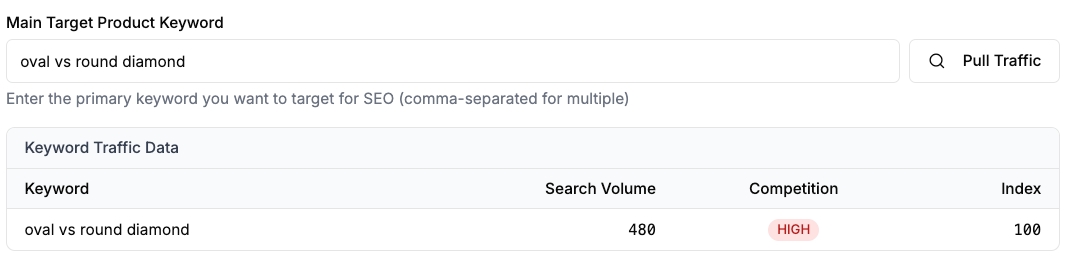
Different keywords belong to different pages at different stages of the buying cycle. Early-funnel comparison queries (“lab-grown vs mined diamonds,” “oval vs round engagement ring”) belong on blog and guide pages. Mid-funnel descriptive product queries (“2 carat oval lab-grown diamond ring,” “14k gold necklaces”) belong on product pages. Late-funnel local keywords (“engagement rings near me,” “jewelry repair Austin”) belong on location and service pages. Group the cluster around the life events your store serves, from engagements to anniversaries to birthdays.
Assign a distinct primary keyword to each page so the site does not compete against itself. When two product or category pages chase the same term, they split rankings and cannibalize each other, which drags down keyword rankings across both. A clean keyword map, refreshed each quarter as trends shift, keeps every page pointed at a unique query, protects your search rankings, and makes internal linking far more effective.
On page SEO is where keyword research, on page optimization, and descriptive copy come together on the pages that actually convert. For jewelry websites, the biggest wins happen on individual product pages, because that is where buyers make a high-consideration decision.
Product titles should embed the terms buyers actually search, not internal labels. “Snowy Fox Enameled Necklace” beats “Fox Necklace,” and “14k Rose Gold 1ct Oval Lab-Grown Diamond Ring” beats “Diamond Ring.” Write descriptions conversationally, as if you were helping a customer at the counter, and weave attributes in naturally rather than stuffing keywords, which Google now penalizes.
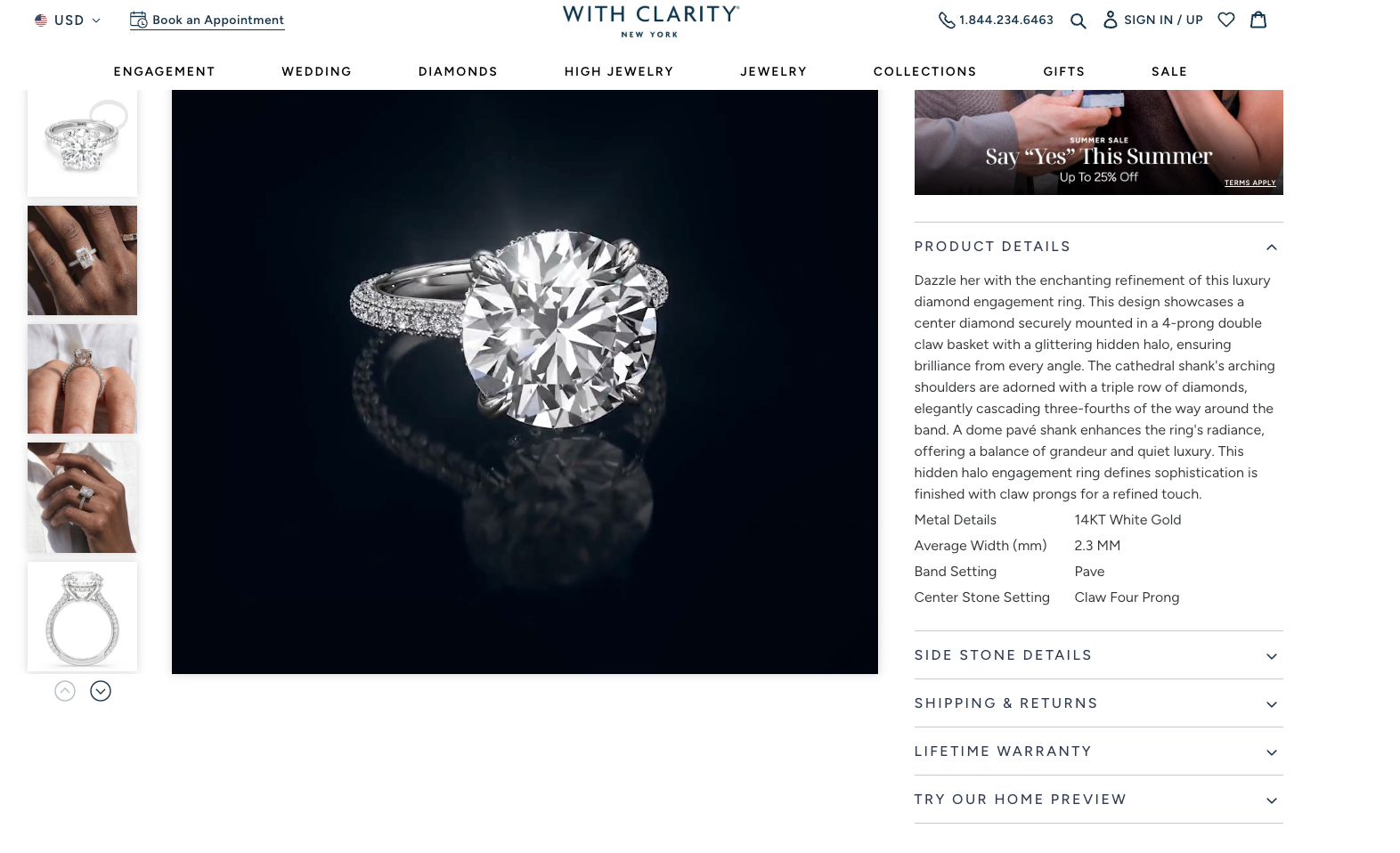
Because buyers cannot hold the piece, the product page has to do the work. Include metal and karat, gemstone type and origin, carat weight, cut and clarity, dimensions, setting, occasion, recipient, care notes, and any customization options. Avoid duplicate descriptions across variants like metal color or size, and add unique value or use canonical tags to consolidate ranking signals. Display customer reviews on the page for fresh, keyword-rich, trust-building content.
Write meta titles, meta descriptions, and other meta tags with the target keyword woven in naturally, and override the platform defaults rather than letting them auto-generate. Keep the language conversational and avoid keyword stuffing, which Google now penalizes. Use a clean heading hierarchy, one H1 for the page topic and H2 or H3 sections for Overview, Specifications, Care, Sizing, and Reviews, and keep URLs short and keyword-bearing. These on page seo strategies give each listing its best shot at strong search engine rankings.
A logical structure helps crawlers and shoppers navigate the catalog and is what lets the site scale without orphan pages. It also makes internal linking, which distributes authority from your content to your products, actually work.
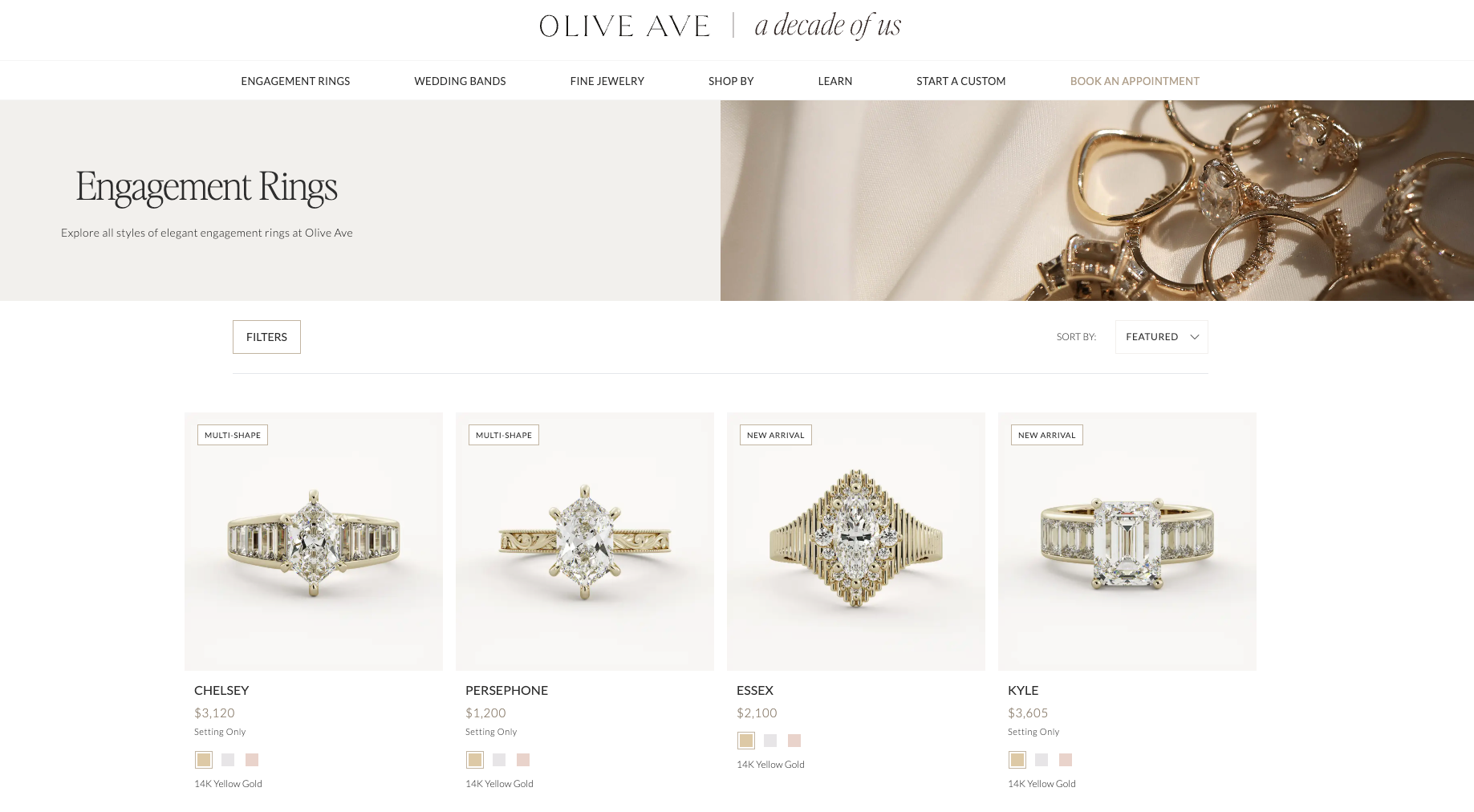
Organize the catalog the way shoppers browse, the way the best jewelry store websites do: Rings into Engagement, Wedding Bands, and Anniversary, and so on down each branch. Category and collection pages should target broad descriptive terms and carry keyword-rich headings and intro copy, because they often rank for higher-volume search results than individual products. Build the hierarchy to scale so every new SKU slots into an existing branch.
Schema markup helps search engines understand your products and lets them display ratings, prices, and availability directly in the search results, which lifts click-through rate. Implement a product data schema on every listing, use a “review schema” for star ratings, FAQ schema on guides and product Q&A, and LocalBusiness schema on contact and location pages. Validate every template against Google’s Rich Results Test before publishing so crawlers parse it correctly.
Apply canonical tags to product variants so color and size URLs consolidate into one ranking signal instead of competing. Maintain a clean XML sitemap of important pages and a robots.txt that keeps low-priority pages out of the index. Short, descriptive, keyword-bearing URLs round out a structure that both crawlers and shoppers can follow.
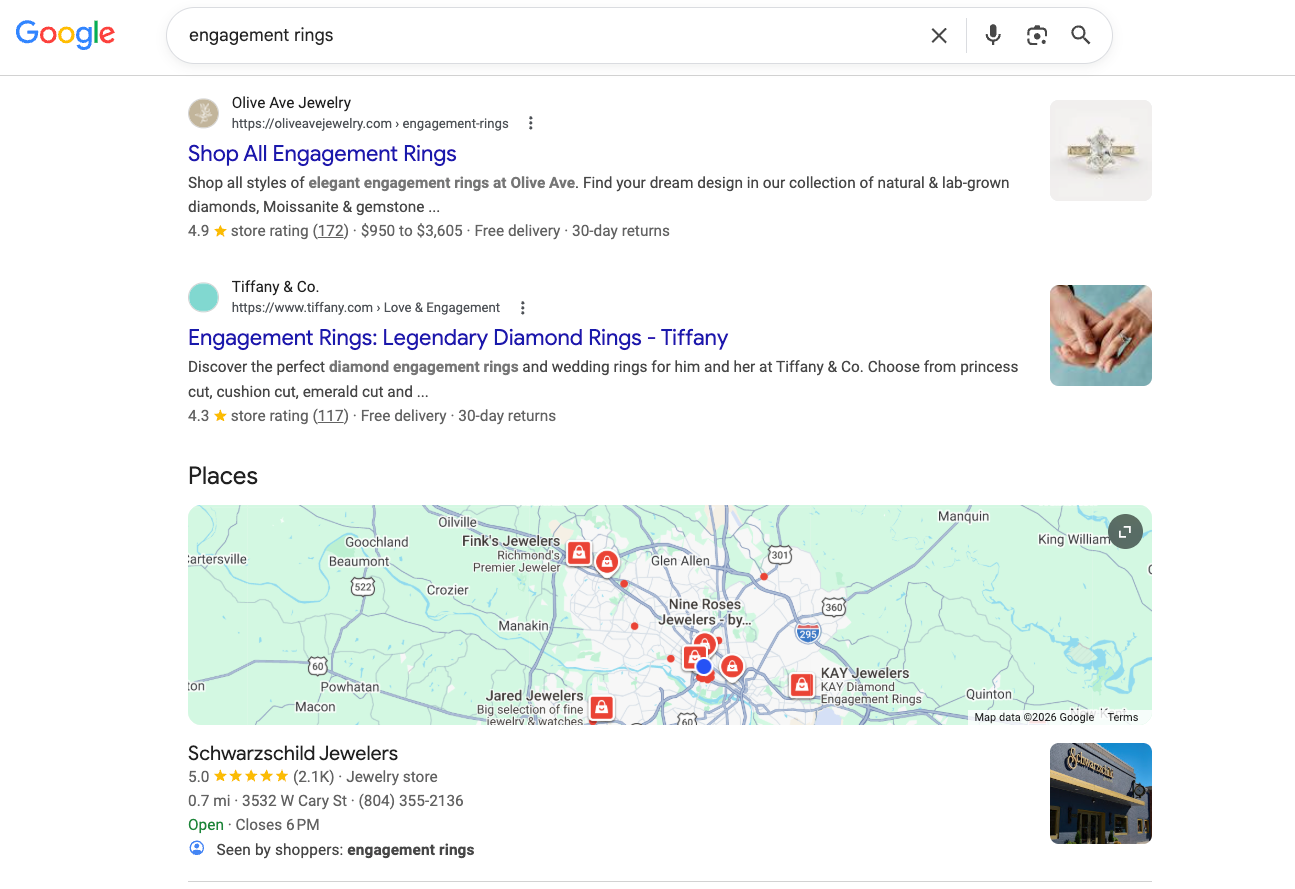
If you have a physical location or service area, local SEO is a high-value complement to the organic work above, not a substitute for it, and the local seo strategies below compound over time. More than three-quarters of nearby smartphone searches lead to a store visit within a day (Google), and the Map Pack of the top three results sits above the standard organic listings in a Google search for “jewelry store near me.” If you sell purely online, lean on the parts that still apply, like consistent business listings and reviews.
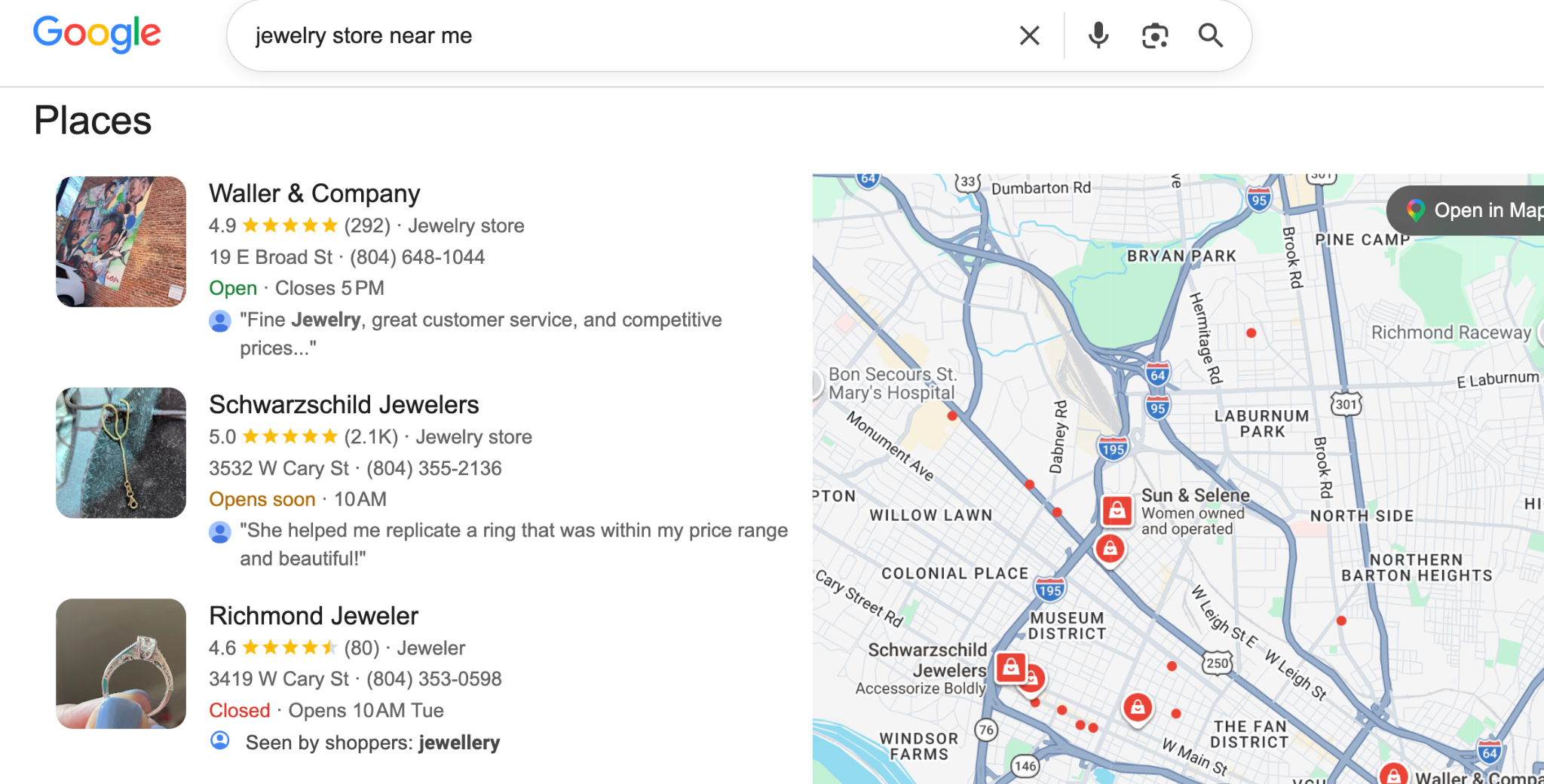
Claim the Google Business Profile and complete every field: accurate name, address, and phone, hours, categories like Jeweler and Jewelry store, services, and product listings. A complete profile is what ranks local jewelry stores in Google Maps and the Map Pack. Add 15 to 30 high-quality photos of the showroom, staff, and pieces, and keep the profile fresh with posts about new collections, events, and seasonal promotions. Embed a Google Map on your contact page to reinforce address accuracy and keep visitors on-site.
Your name, address, and phone number must match exactly everywhere they appear. Submit consistent NAP to Yelp, Bing Places, Apple Maps, Facebook, and jewelry-specific directories, and claim and verify each listing so the “claimed and verified” badges build trust. Inconsistent NAP is one of the quietest killers of local rankings for local businesses, and tools like Moz Local or Yext manage listings across dozens of directories from one dashboard.
Create a dedicated page for each showroom or service area, such as “Engagement Rings in Brooklyn, NY.” Work the city and neighborhood in as local keywords across the title, meta description, headers, and body, add directions, parking notes, hours, an embedded map, and local reviews, then apply LocalBusiness schema. These pages capture the high-intent local searches that bring more local customers in for appointments and walk-ins.
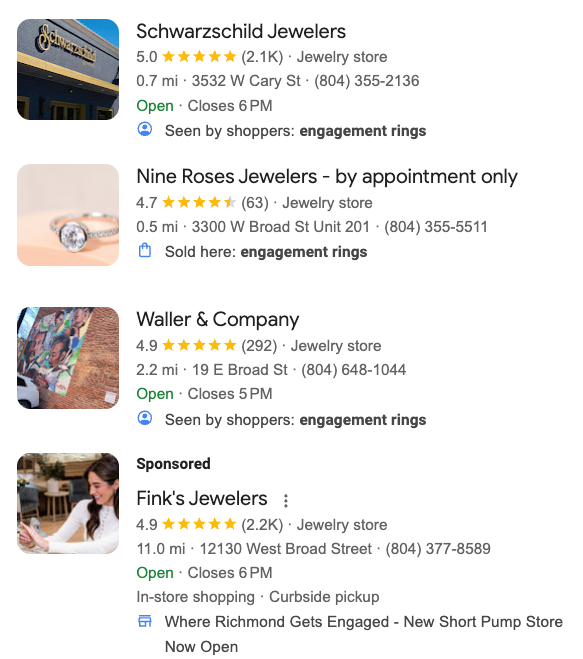
Reviews are both a ranking factor and a trust signal in the Map Pack. Encourage satisfied customers to leave a Google review after a purchase, repair, or showroom visit, and respond to all of them, positive and negative. Reviews from satisfied customers build trust with potential customers, inject locally relevant keywords, and improve SEO, while thoughtful responses to negatives repair credibility that unanswered complaints would damage.
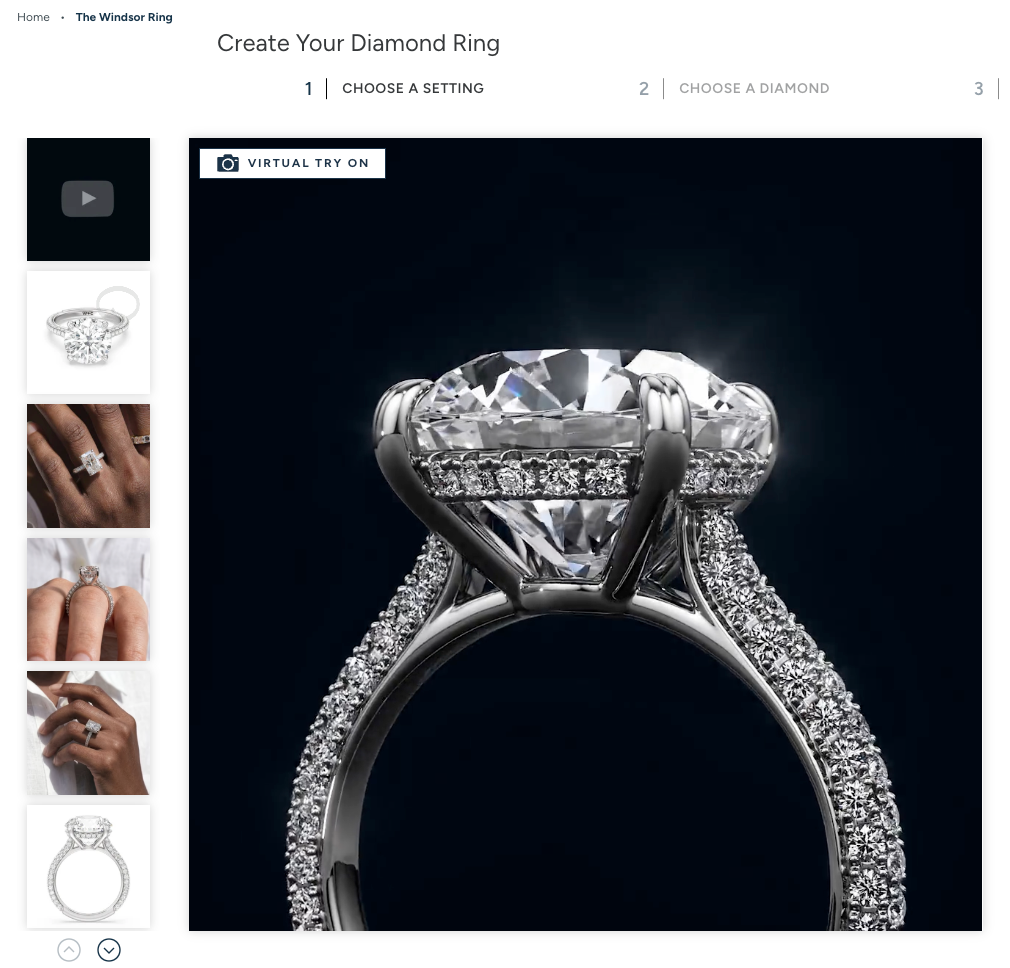
Visual evaluation carries unusually heavy weight in jewelry. Buyers shopping for jewelry online want to judge scale, finish, and sparkle before committing, which makes rich media both a conversion tool and a ranking signal.
Shoot every piece from multiple angles with macro detail on stones and hallmarks, and add 360-degree spins for high-AOV items. Where the platform supports it, add AR ring and ear try-ons, plus utilities like a printable ring sizer, a necklace-length visualizer, and a financing calculator. These reduce friction at the conversion point and earn the engagement signals search engines reward.
Content marketing pulls in buyers who are early in a long research cycle, and for jewelry it does double duty by building the trust a high-AOV purchase requires. Consistent content creation and fresh website content rank for a far wider keyword set than the product catalog alone and seed internal links to product pages.
Build evergreen guides first: ring sizing, the 4Cs of diamonds, metal and alloy primers, gemstone care, and insurance, return, and warranty policies. These rank for foundational buyer questions and seed internal links down to product and category pages. Write blog posts of 300 to 500 words for general topics, which is fine as long as they are useful and refreshed periodically.
Neutral comparison content captures high-intent decision queries that giant retailers underserve: diamond versus moissanite, oval versus round, prong versus bezel, and lab-grown versus mined. Cover ethical sourcing topics too, from the Kimberley Process to recycled metals and conflict-free sourcing, because these directly address the trust concerns that drive jewelry research.
Bench videos, atelier photo essays, repair walkthroughs, and custom-piece case studies are formats specific to jewelry that catalog-only competitors cannot match. They show craftsmanship, earn engagement, and pull in long-tail queries around bespoke and custom work like custom wedding bands, which is one of an independent jeweler’s strongest differentiators. Create occasion hubs for Valentine’s Day, weddings, and December gifting, and keep their URLs consistent year over year.
Jewelry is among the highest-trust purchases in retail, and the signals that build trust also build rankings. Make certifications (GIA, IGI), ethical-sourcing details, return and warranty policies, and insurance options easy to find on product pages and in dedicated content. Set up Google Alerts to monitor brand mentions and reviews, keep every directory listing current, and engage on Instagram and Pinterest, which surface in Google and other search engines and feed the brand searches that lift SEO indirectly.
High quality backlinks from authoritative, on-topic sources act as endorsements and grow your domain authority, and for jewelers the most valuable ones are local and industry-relevant. This off page SEO rewards quality and relevance over volume every time.
Partner with jewelry and lifestyle bloggers, fashion bloggers, wedding and bridal sites, photographers with a social media presence, and YouTube creators for reviews and styling content, and trade a backlink with the photographer who shoots your catalog. The target audience already cares about jewelry, and the content generates links and brand searches for years. Avoid bulk link packages, link farms, and directory dumps, which Google penalizes.
Technical SEO keeps the site fast, mobile friendly, and easy for search engines to crawl. For jewelry, two areas matter most because of the mobile-to-desktop journey across mobile devices and frequently changing inventory.
Google indexes the mobile version of your site, and jewelry shoppers discover on mobile before switching to desktop, so mobile-first responsive design is non-negotiable. Audit Core Web Vitals (LCP, INP, CLS) with PageSpeed Insights and fix the worst pages first, since heavy hero images and late-loading review widgets are common culprits. Test on multiple devices with Google’s Mobile-Friendly Test.
Keep the site easy to crawl. Fix broken links, especially internal ones, which proliferate when product URLs change or pieces are discontinued, and resolve redirect chains so authority does not leak. Maintain a clean XML sitemap and a properly configured robots.txt, and run a full audit twice a year to catch crawl errors, index bloat, and schema issues. Consider a Google Merchant Center account so products can appear in Google Shopping above the standard SERP.
Every best practice above adds up to real work when a jewelry catalog runs into hundreds or thousands of SKUs and many descriptions start as sparse vendor copy. The Pumice Product Optimization Playbook automates the per-product SEO optimization: you feed it an existing listing and a target keyword, and it returns a structured marketing brief that tells you exactly what to change to rank. It is built for flagship pieces, slow movers, and every new launch.
Open the Playbook and paste in the existing product title, description, and supporting attributes, which for an engagement ring means metal and karat, carat weight, stone type and shape, setting, and certification. Enter the main target keyword and hit Pull Traffic to see live search volume, difficulty, and ranking potential, which doubles as quick keyword research before you commit. Enter your own domain so the system excludes your pages from the competitor analysis.
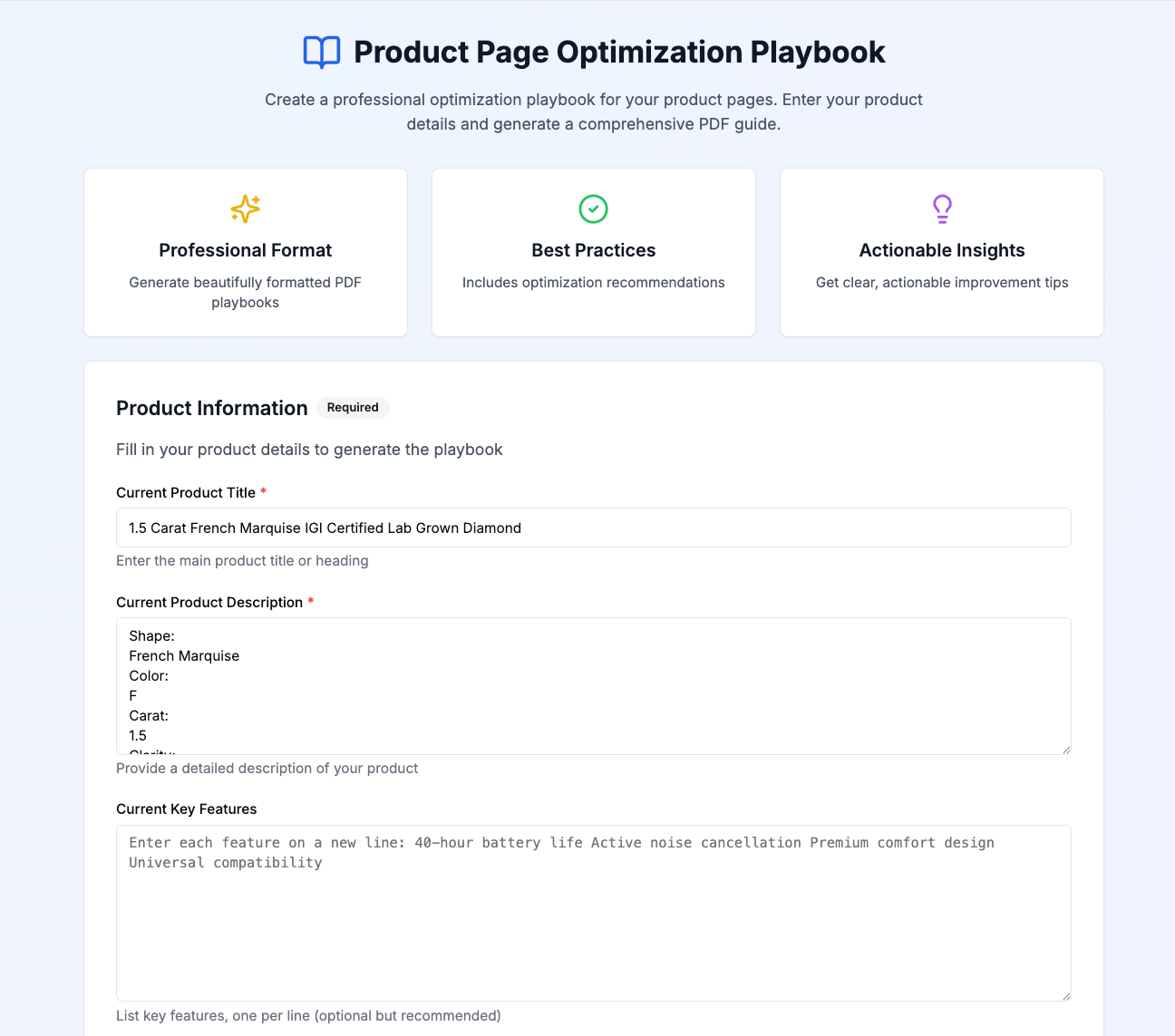
Once you submit, the Pumice Agentic System runs gap analysis, competitor analysis, SEO keyword analysis, and on-page metrics in the background against the first-page SERP for your keyword. The agents do not invent product facts. They read the listings already ranking for a product like yours, surface the patterns those winners share, and compare them against your page.
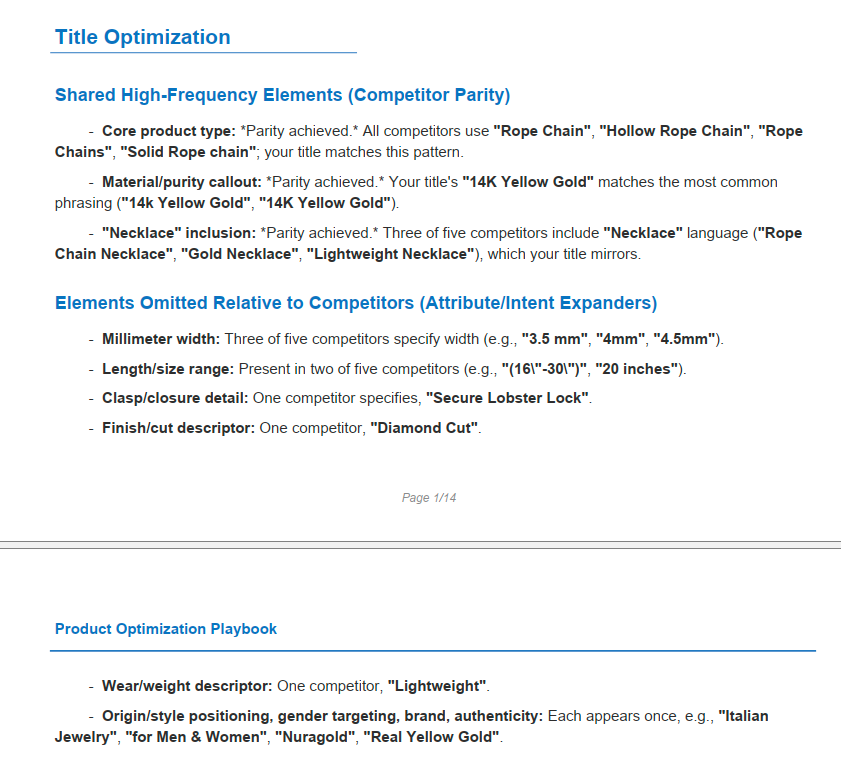
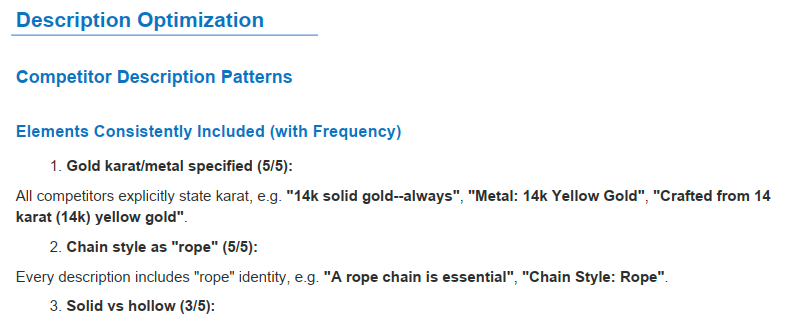
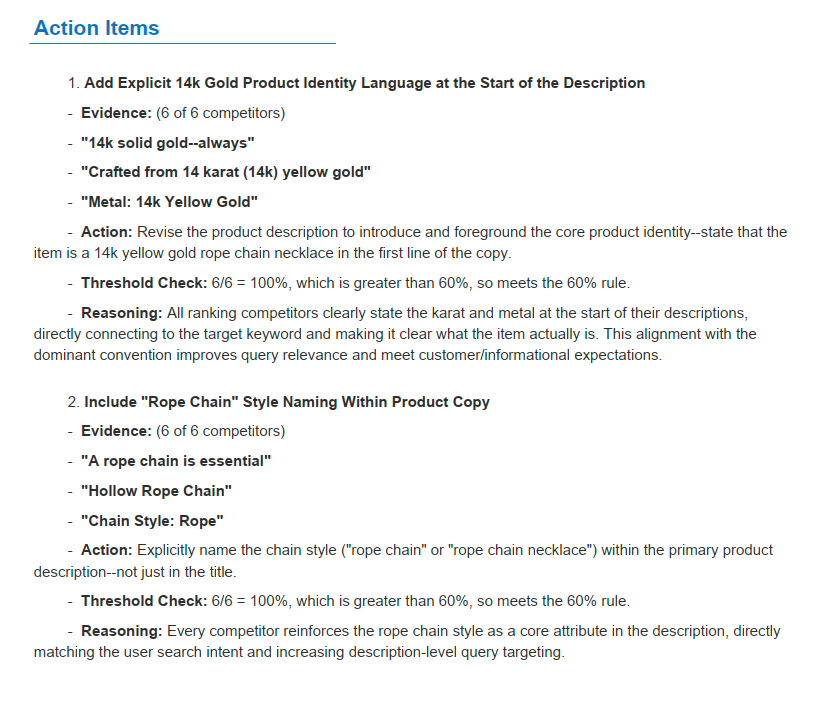
The Playbook returns a structured PDF that breaks down your current product data, the competitor data from the first-page SERP, the gap analysis between the two, and a list of specific action items. It includes a keyword distribution analysis showing which ranking terms appear in the top competitor titles, descriptions, images, and review blocks, and which are missing from yours. Every action item carries four pieces of information: the action to take, the evidence behind it, a threshold check showing how many competitors do it, and the reasoning.
On the gold necklace page targeting “14k gold rope chain necklace,” the title data analysis section shows key missing attributes from the title. The differences are where the value sits: 3 of 5 put chain width in the title.
The description analysis section flags all competitors state the karat in the description.
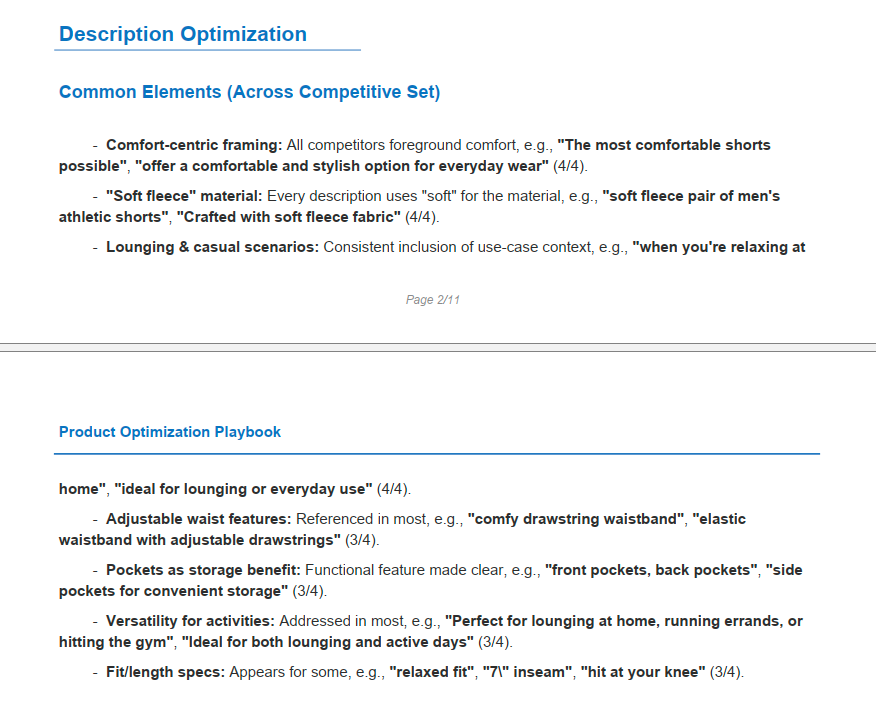
The Playbook flags each gap with a threshold count and a recommended fix.
Run the Playbook on flagship SKUs where you want the page performing at its best, on slow movers where the report often reveals a thin description or a missing attribute, and on every new listing so launch copy ships SERP-ready. Apply the changes, rerun to confirm the gap is closed, and move to the next piece, repeating the same per-page rigor at catalog scale.
Track keyword rankings for real product queries like “2 carat oval lab-grown diamond ring” and “14k gold huggie earrings” alongside local-intent terms like “engagement rings near me” and “jewelry repair [city].” Monitor your presence in the search engine results pages and SERP features (product, review, and FAQ schema) in Google Search Console or Ahrefs, and use Google Analytics (GA4) to tie landing-page traffic to assisted conversions, last-click revenue, and call or appointment volume. Keep organic separate from Google Ads to see what SEO earns on its own. For seasonal hubs, compare pre-season, in-season, and post-season cohorts year over year and plan refreshes 6 to 8 weeks before each retail peak.
Jewelry SEO rewards stores that treat it as a system, not a project. Descriptive product pages convert long-tail buyers, trust and comparison content shortens long research cycles, rich visuals and reviews build credibility, technical hygiene keeps everything fast, and local search adds showroom appointments wherever you have a location. Layer the Pumice Product Optimization Playbook on top for the per-SKU work. Start with a 30-day plan: rewrite the titles and descriptions for your five highest-revenue pieces with the Playbook, fix your three worst Core Web Vitals pages, publish two evergreen guides, and, if you have a storefront, complete the Google Business Profile. Measure the lift in Search Console and GA4 at day 30, 60, and 90.

Pumice.ai's Product Optimization Playbook gives you the exact strategy for optimizing your PDPs with data driven insights that you can analyze directly. Try for free today: https://app.pumice.ai/playbook
Most jewelers see organic and local lift within 2 months of consistent work on the Google Business Profile, product pages, and technical fixes. Competitive terms like “engagement rings” can take 3 to 6 months as algorithms favor authority, while long-tail and local queries move faster. Treat jewelry SEO as a compounding long-term channel that brings in more customers rather than a one-time project.
It depends on the model. A showroom-first jeweler should lead with local SEO, meaning Map Pack visibility, reviews, and location pages, because late-funnel local searches convert best. A primarily online brand should weight product-page and content SEO while still covering local for the regions it serves. Most hybrid jewelers run both and revisit the split every 6 to 12 months.
Target descriptive long-tail product terms (“14k gold huggie earrings,” “vintage oval diamond engagement ring”), local-intent terms (“jeweler near me,” “ring sizing [city]”), and educational or comparison queries (“the 4Cs explained,” “lab-grown vs mined diamonds”). Avoid generic head terms like “jewelry,” where national giants and marketplaces dominate and ranking is impractical.
Very. Reviews are a direct ranking factor in the local Map Pack and a major trust signal for a high-AOV purchase. Solicit Google reviews after every sale, repair, and showroom visit, respond to all of them, and display reviews on product pages for fresh, keyword-rich content that also reinforces credibility.
Yes for the basics: maintaining the Google Business Profile, requesting reviews, keeping NAP consistent, publishing simple guides, and running keyword research per product. Advanced work like schema rollout, technical audits, and large-scale content or link building usually benefits from outside help, or from a tool like Pumice that automates the per-SKU optimization.


.png)